

Bookkeeper vs accountant vs tax preparer: all three work with a business’s numbers, so it’s easy to mix them up. But they do different jobs, need different training and carry different responsibilities. If you’re thinking about bookkeeping as a work-from-home career, knowing the difference is the first thing to get right.
The short version: the bookkeeper keeps the records, the accountant analyzes them and advises, and the tax preparer turns them into tax returns. Many small businesses need all three, and they work best as a team.
In this guide we explain what each one does, the usual training and credentials, where a bookkeeper’s job stops and how the three work together through the year. This is general awareness only. Rules about titles and licensing vary by state and country, so check your local rules or ask a professional.
Bookkeeper vs accountant vs tax preparer: the quick answer
- Bookkeeper: records and categorizes transactions, reconciles accounts, closes each month and sends simple reports. Keeps the books clean and up to date.
- Accountant: reviews and analyzes the books, makes adjustments, prepares financial statements and gives financial and often tax advice. A CPA is a licensed accountant.
- Tax preparer: prepares and files tax returns using the business’s records. Can be a CPA, an enrolled agent, a tax attorney or another paid preparer.
- Where a bookkeeper stops: no tax returns, no tax advice, no legal or investment advice. Clean books get handed to the tax professional.
What does a bookkeeper do?
A bookkeeper handles the day-to-day and month-to-month record keeping. Think of the bookkeeper as the person who makes sure every number is in the right place, every month.
- Categorize transactions: sort sales, expenses and transfers into the business’s chart of accounts (its list of categories).
- Organize receipts: collect receipts, attach them to transactions and follow up on missing ones.
- Track invoices and bills: send invoices, track who owes money and enter bills for the owner to approve and pay.
- Reconcile: match the books to bank and credit card statements each month.
- Close the month: clean up loose ends and run the profit and loss and balance sheet.
- Report: send the owner the reports and a plain-English summary.
- Coordinate: record payroll from the client’s payroll provider and prepare a year-end package for the tax pro.
Bookkeepers usually work in software like QuickBooks Online, Xero or Wave. Most of the math is done by the software. The skill is accuracy, consistency and noticing when something looks wrong.
What does an accountant do?
An accountant works at a higher level with the same numbers. Where the bookkeeper records, the accountant reviews, interprets and advises. Depending on their training and license, an accountant may:
- Review the books: check the bookkeeper’s work and make adjusting entries, for example for depreciation.
- Prepare financial statements: formal statements for lenders, investors or owners.
- Advise: help with budgeting, forecasting, business structure, cash flow and big decisions.
- Plan taxes: many accountants also prepare tax returns and give tax planning advice.
- Audit or review: certain formal assurance work, like audits, is generally limited to licensed CPAs.
Accountant vs CPA
“Accountant” is a broad word. A CPA (certified public accountant) is an accountant who has met their state’s education, exam and experience requirements and holds a license. In the US, only licensed people can call themselves CPAs, and some states also restrict other titles that include the word “accountant”. Other countries have their own designations and rules.
What does a tax preparer do?
A tax preparer prepares and files tax returns for individuals and businesses. They take the year’s records, apply the tax rules and complete the forms. Tax preparers can have very different backgrounds:
- CPAs: licensed accountants, many of whom specialize in tax.
- Enrolled agents: tax specialists licensed by the IRS, usually after passing its exam.
- Tax attorneys: lawyers who focus on tax law.
- Other paid preparers: people who prepare returns for a fee, often seasonally.
In the US, anyone who prepares federal tax returns for pay needs a preparer tax identification number (PTIN) from the IRS, and a few states add their own requirements. CPAs, enrolled agents and tax attorneys can also represent clients before the IRS, while other preparers have more limited rights. Rules change, so check the IRS website and your state for current details.
Bookkeeper vs accountant vs tax preparer, side by side
Main job
- Bookkeeper: keeps accurate, up-to-date records every month.
- Accountant: reviews, adjusts and interprets the records, and advises.
- Tax preparer: prepares and files tax returns.
When the business sees them
- Bookkeeper: every week or month, all year.
- Accountant: a few times a year, or for big decisions.
- Tax preparer: mainly at tax time, plus estimated tax questions during the year.
Typical training and credentials
- Bookkeeper: no degree needed in most places. Software certifications (such as QuickBooks Online ProAdvisor or Xero, free at the time of writing) and optional bookkeeping certifications help build credibility.
- Accountant: usually an accounting degree. A CPA also needs a state license.
- Tax preparer: depends on the type, from a PTIN (and any state requirements) to an enrolled agent license, CPA license or law degree.
Who gives tax advice
- Bookkeeper: no.
- Accountant: often, depending on their training and license.
- Tax preparer: yes, within their qualifications.
Where a bookkeeper’s job stops
This is the most important part for anyone starting a bookkeeping business. Staying in your lane protects your clients and protects you. As a bookkeeper, you don’t:
- Prepare or file tax returns, including sales tax or payroll tax filings, unless you’re separately qualified and it’s in your agreement.
- Give tax advice, such as whether an expense is deductible, which business structure to choose or how much to set aside for taxes.
- Give legal or investment advice.
- Decide the accounting method: cash or accrual basis is the tax pro’s call.
- Move money: the owner approves and pays bills. You never use the client’s bank login.
- Run payroll or file payroll taxes: you coordinate with the client’s payroll provider and record payroll in the books.
- Call yourself an accountant or CPA. You’re a bookkeeper, and that’s a valuable job on its own.
When a client asks a tax question, the answer is simple and kind: “Great question for your tax pro. I’ll make sure they have clean numbers to work with.” Put these limits in your engagement letter too, so everyone knows the scope from day one.
Do it with AI: ask Claude: “I’m a bookkeeper, not a tax preparer or accountant. A client just asked me: [PASTE CLIENT’S TAX QUESTION]. Write a short, warm reply under 100 words that explains I can’t give tax advice, suggests they ask their tax professional, and offers to send the tax pro any reports or records they need. Don’t answer the tax question itself. Ask me questions first if anything is unclear.” Then read it, make it sound like you, and send it yourself.
Outside the US
Rules vary a lot from country to country. As examples, in the UK businesses that offer bookkeeping services generally need anti-money laundering supervision, and in Australia people who provide certain business tax (BAS) services for a fee must be registered. Professional accounting titles are protected in many countries. Wherever you live, check your local rules before you start, and ask a professional if you’re unsure.
How the three work together
Here’s an example year for a small business, say a home cleaning company with two crews:
- Every month: the bookkeeper categorizes transactions, chases receipts, reconciles the bank and card accounts, closes the month and sends the owner a report.
- A few times a year: the accountant or tax pro reviews the numbers, answers the owner’s questions and advises on estimated taxes.
- At year-end: the bookkeeper prepares a year-end package of reports and documents. The tax preparer uses it to prepare and file the returns.
The better the bookkeeping, the faster and cheaper the tax pro’s job. That’s why CPAs and tax preparers are often a bookkeeper’s best source of referrals: they want clients with clean books.
Tip: introduce yourself to a few local tax professionals. Explain what you do and what you don’t do, and ask what they’d like in a year-end package. Being easy to work with is a real selling point.
Which one does a small business need?
- A bookkeeper if the owner is behind on records, doesn’t know their profit or dreads tax time.
- An accountant for financial statements, big decisions, planning and advice.
- A tax preparer to prepare and file returns correctly.
Many small businesses start with a bookkeeper and a tax preparer, then add an accountant’s advice as they grow. Some accounting firms offer all three under one roof.
Which career fits you?
If you love order, detail and a steady monthly rhythm, bookkeeping is the most accessible place to start from home. You can learn the basics and the software without a degree, and many clients pay a monthly retainer. Our guide to how to become a bookkeeper from home walks through each step, and how much do bookkeepers charge shows example packages and math.
Bookkeeping can also be a stepping stone. Some bookkeepers later study accounting or tax and earn a credential, and the hands-on experience helps. If you’d like more background first, read our guide to becoming a work from home bookkeeper.
Learn the bookkeeper’s job, step by step
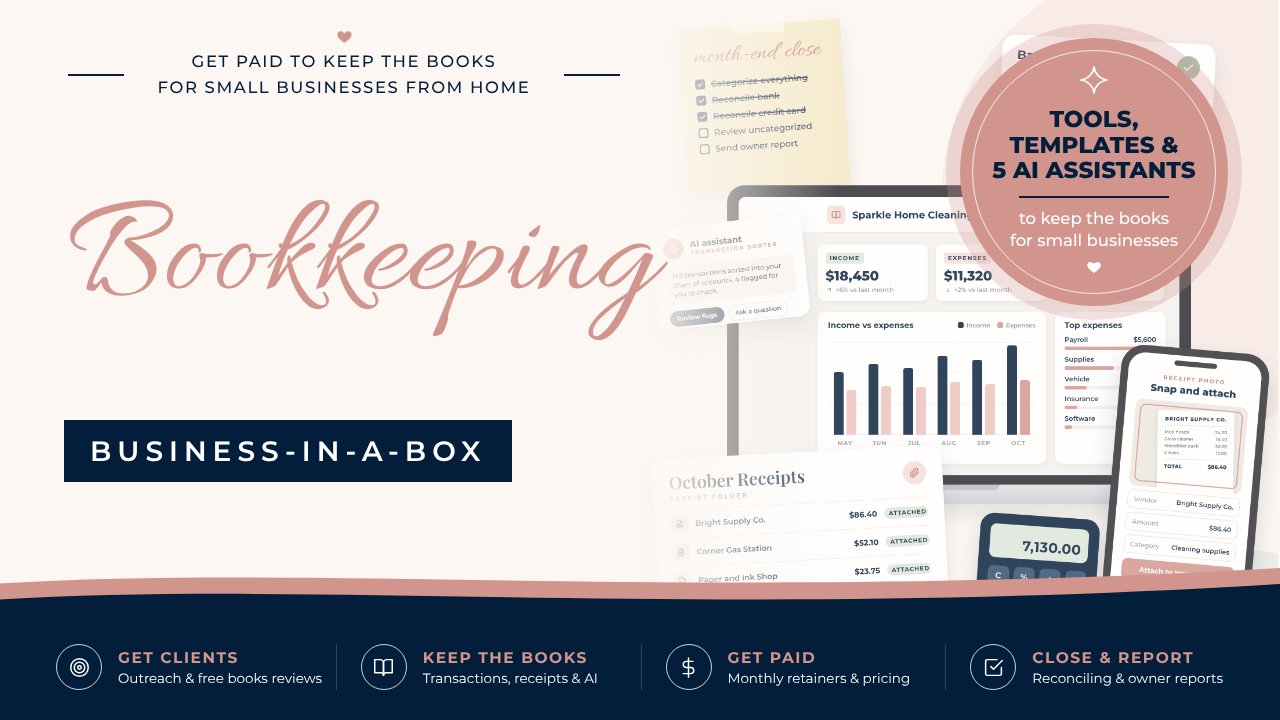
Our Bookkeeping Business-in-a-Box gives you 12 modules, 52 short written lessons, 18 templates and 5 AI assistants in Claude (Transaction Sorter, Reconciliation Helper, Report Writer, Catch-Up Planner and Client Finder), plus the AI Bookkeeping Playbook bonus with 50 AI workflows and a Month-End Procedures Pack. It’s $197, self-paced, with no videos to sit through.
Bookkeeper vs accountant: FAQ
Is a bookkeeper the same as an accountant?
No. A bookkeeper records and organizes the day-to-day finances. An accountant reviews and interprets them, makes adjustments and gives advice. Bookkeepers shouldn’t call themselves accountants.
Can a bookkeeper do my taxes?
No. Bookkeepers keep the books and hand clean records to a tax professional, such as a CPA, enrolled agent or other qualified preparer, who prepares and files the return and gives tax advice.
Do you need a license to be a bookkeeper?
In most of the US, no license is required to work as a bookkeeper, though business registration rules still apply. Some countries do have registration or supervision rules, so check your local requirements.
Do I need a bookkeeper if I have an accountant?
Often, yes. Accountants and tax preparers usually work with your books a few times a year, while a bookkeeper keeps them accurate every month. Clean monthly books can make the accountant’s work faster and easier.
Can bookkeepers use AI?
Yes, carefully. AI can pre-sort transactions and draft reports, but the bookkeeper checks everything, gets the client’s OK first and never shares passwords or full account numbers. Our guide to how to use AI for bookkeeping covers the safety rules.
See what a bookkeeper’s month looks like
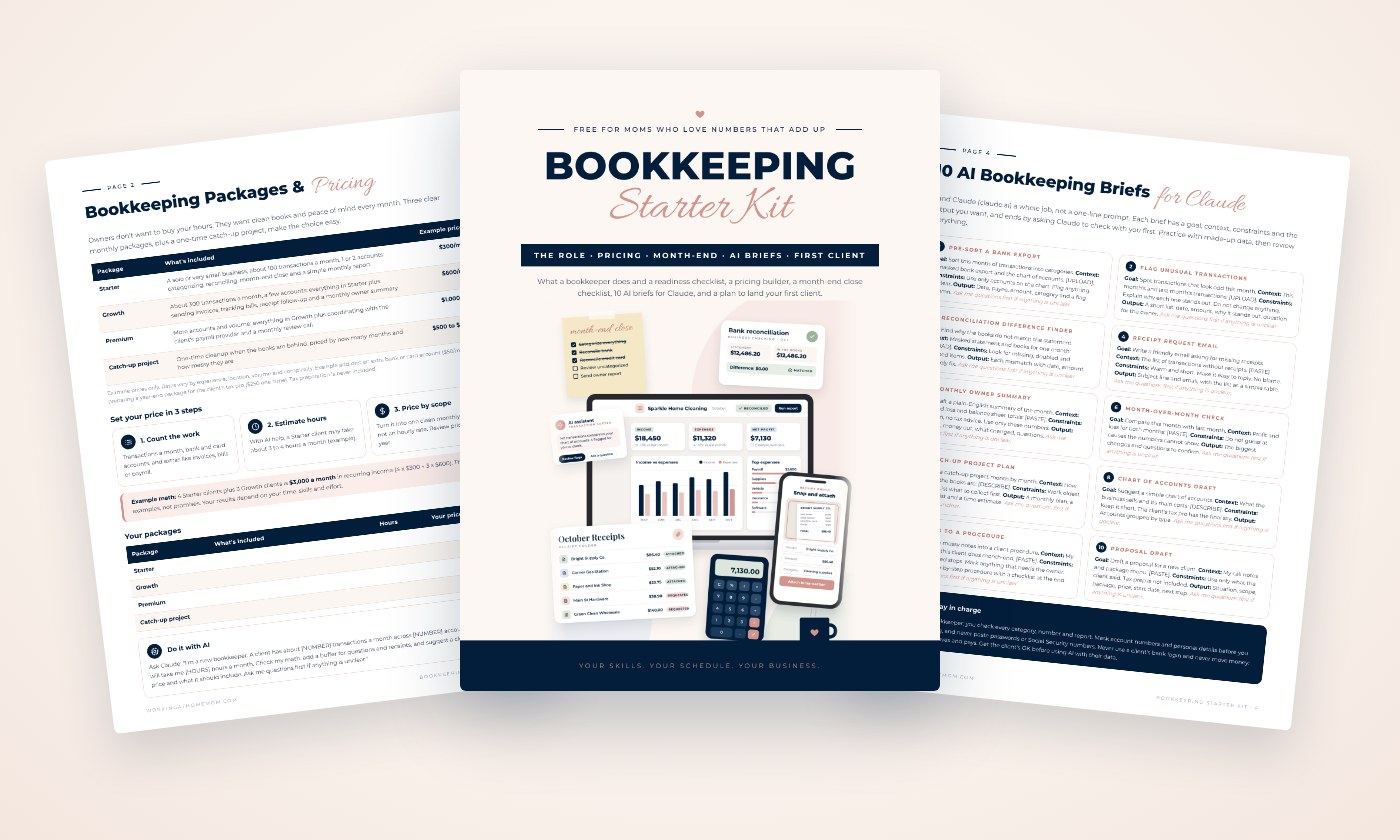
Example bookkeeping packages and pricing, a month-end close checklist, 10 ready-to-paste AI briefs and a 10-step plan to land your first client. Sent straight to your inbox.





