Etsy vs Shopify is one of the first big decisions you’ll face when you start selling online. Both are popular, both can work beautifully for a mom selling from home, and both have trade-offs that aren’t obvious until you’re a few months in.
The short version: Etsy is a marketplace that brings you shoppers, and Shopify is a tool for building your own store that you have to bring shoppers to. In this guide we compare them honestly, side by side, so you can pick the one that fits your products, your time and your goals.
Etsy vs Shopify: the quick answer
- Choose Etsy if you sell handmade, vintage, digital or print-on-demand items and want shoppers fast with very little setup.
- Choose Shopify (or another own-store platform like Bonidi) if you want your own brand, full control and your own customer list, and you’re ready to market.
- Choose both if you want Etsy’s traffic now while you build a store you own. Many sellers do exactly this.
Etsy vs Shopify: side-by-side comparison
| Feature | Etsy | Shopify |
|---|---|---|
| What it is | A marketplace where many shops sell side by side | A platform to build your own standalone store |
| Traffic | Built-in shoppers already searching | You bring your own visitors |
| What you can sell | Handmade, vintage, craft supplies and items you design (including digital and print-on-demand) | Almost any legal product, including wholesale, resale and dropshipping |
| Fees | Setup fee, listing fees, transaction and payment processing fees, plus ad fees on some sales | Monthly plan, payment processing fees, plus optional paid themes and apps |
| Ease of setup | Very easy, often an afternoon | Easy to start, more to learn to do well |
| Branding and design | Limited: logo, banner and photos | Full control with themes and your own domain |
| Customer list | Buyers are Etsy’s customers, with limits on marketing to them | Your customers, and you can build your own email list |
| Competition | Competitors shown right next to your listings | Only your products on your site |
| Best for | Beginners testing products, makers, digital sellers | Brands ready to grow, sellers with an audience or a marketing plan |
Fees on both platforms change from time to time and can vary by country, so check current pricing on Etsy’s fees page and Shopify’s pricing page before you decide.
Traffic vs control: the real difference
Almost every Etsy vs Shopify question comes down to this trade-off.
Etsy gives you traffic. Millions of shoppers go to Etsy specifically to buy gifts, printables, home decor and personalized items. A brand-new shop with good listings can get found through Etsy search without any outside marketing. That’s huge when you’re just starting.
Shopify gives you control. Your store looks the way you want, your products don’t sit next to a competitor’s, and you set your own policies within the law. But nobody knows your store exists until you tell them through Pinterest, social media, email, search or ads.
Tip: think of Etsy like renting a booth at a busy craft fair, and your own store like opening a shop on a quieter street that you own. The fair brings foot traffic, but the organizer sets the rules and you can’t take the crowd home with you.
Fees: how each platform charges
We don’t list exact numbers here because they change, but here’s how each platform structures its fees so you know what to look for.
Etsy fees
- Setup fee: a one-time fee when you open your shop in many countries.
- Listing fee: a small fee per listing, which renews when the listing expires or an item sells.
- Transaction fee: a percentage of each sale, including shipping.
- Payment processing fee: charged on each payment through Etsy Payments.
- Offsite Ads fee: charged only when a sale comes from an ad Etsy runs on other sites. Shops above a certain yearly sales level can’t opt out.
- Etsy Ads: optional ads inside Etsy, with a budget you set.
Shopify fees
- Monthly plan: a subscription, with several plan levels.
- Payment processing: charged on each card payment.
- Extra transaction fee: charged if you use an outside payment provider instead of Shopify Payments.
- Themes and apps: many are free, some are paid, and app subscriptions can add up quickly.
- Domain: your own web address is a small yearly cost.
The takeaway: Etsy costs more per sale but very little up front. Shopify costs a steady monthly amount whether you sell or not, but less per sale. Run your own numbers with real prices from each site.
Ease of use
Etsy is the easier start. You fill in your shop details, add listings and open. Etsy handles hosting, checkout, digital file delivery and sales tax collection in many places.
Shopify is still beginner friendly, with drag-and-drop themes and step-by-step setup. But you’ll make more decisions: theme, pages, navigation, apps, shipping settings, tax settings and payment settings. Plan on a few days to a few weeks to get a store you’re proud of. Digital downloads on Shopify usually need an app, such as Shopify’s own Digital Downloads app.
Do it with AI: open Claude (or ChatGPT) and paste: “I sell [PRODUCTS] to [TARGET CUSTOMER]. I have about [HOURS] hours a week, my marketing experience is [NONE / SOME / A LOT], and I [DO / DON’T] have an audience on social media. Compare Etsy and Shopify for my situation in a simple table, then recommend one, both, or a staged plan, and explain why.” Then check any fee or feature details against each platform’s current pages.
Branding and customer list ownership
This is where Shopify (and other own-store platforms) pull ahead.
- Branding: on Etsy, shoppers often remember “I bought it on Etsy,” not your shop name. On your own store, every page is your brand, your colors and your domain.
- Customer list: Etsy’s rules limit how you can use buyer information. You can’t simply add Etsy buyers to your marketing emails. On your own store, customers can opt in to your email list at checkout.
- Stability: on a marketplace, a policy change, search update or account issue can hit your sales overnight. Owning your store and email list spreads that risk.
What about an all-in-one option like Bonidi?
Shopify isn’t the only way to own your store. Bonidi is the all-in-one system we use. Instead of a store plus separate tools for email, landing pages and funnels, it keeps your website, store, email marketing and sales funnels in one place. That can be simpler if you’d rather not manage a stack of apps.
Whichever own-store platform you pick, the big benefits are the same: your brand, your customers and your rules.
Why many sellers use both
You don’t have to choose forever. A common path looks like this:
- Start on Etsy to test products and get first sales and reviews quickly.
- Learn what sells, which titles get clicks, and what price buyers accept.
- Open your own store with your best sellers, and add a freebie to grow your email list.
- Send repeat customers and social traffic to your own store, while Etsy keeps bringing in new buyers.
Some sellers use apps to sync products and inventory between the two. If you sell physical items in both places, check that your stock counts stay accurate so you don’t oversell.
Just getting started? Read our step-by-step guide on how to start an online store from home, or our Etsy shop setup guide if you’re leaning toward Etsy first.
Which is best for you?
- You’re brand new and want sales fast: Etsy.
- You sell printables or digital products: Etsy to start, then add your own store to build an email list.
- You sell wholesale, resale or dropshipped products: your own store, since Etsy doesn’t allow reselling most ready-made items.
- You already have an audience: your own store, so you keep more of each sale and own the relationship.
- You want to build a lasting brand: your own store, with Etsy as an extra sales channel.
Still deciding what to sell? See our list of the best things to sell online from home.
Etsy, your own store, or both? We’ll walk you through it
Online Shop Business-in-a-Box shows you how to pick products, set up your store in Bonidi or Shopify, sell on Etsy too, and launch, with templates and AI assistants for every step.
Etsy vs Shopify FAQ
Is Etsy or Shopify better for beginners?
Etsy is usually easier for beginners because it’s quick to set up and already has shoppers. Shopify is a better fit once you’re ready to build a brand and market your own store.
Is Shopify cheaper than Etsy?
It depends on how much you sell. Etsy has low upfront costs but takes fees from every sale. Shopify has a monthly cost but lower per-sale fees. Compare current pricing on both sites using your own expected sales.
Can I sell on Etsy and Shopify at the same time?
Yes. Many sellers do. Apps can help sync listings and inventory, and each platform’s own rules still apply to what you sell there.
Can I dropship on Etsy?
Generally no. Etsy doesn’t allow reselling ready-made items you didn’t make or design, with exceptions for vintage and craft supplies. Print-on-demand of your own designs is allowed with a disclosed production partner. Check Etsy’s current policies.
Do I need a website if I sell on Etsy?
You don’t need one to start. But a simple website or own store lets you build an email list and a brand that doesn’t depend on one marketplace.
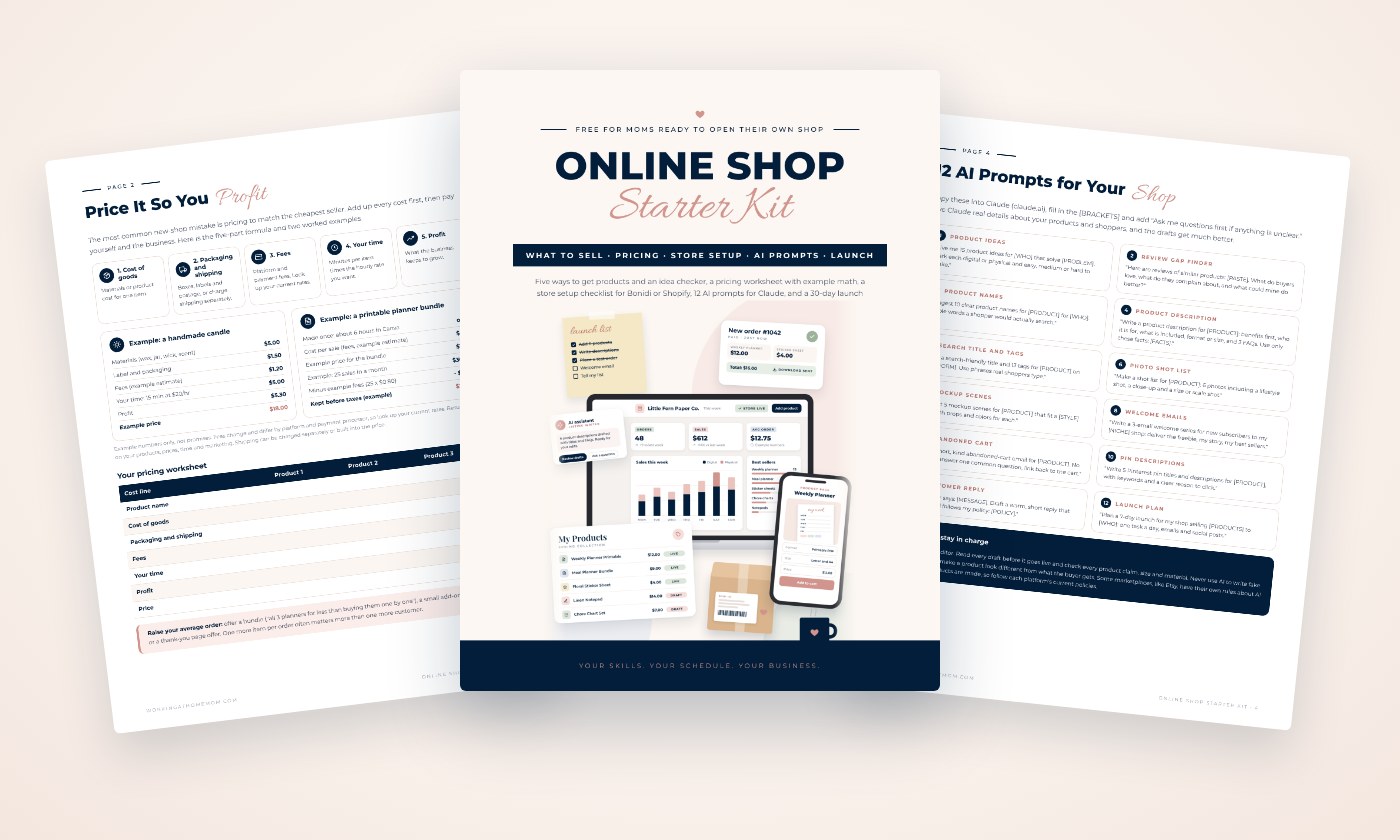
Plan, price and launch your shop
Five ways to get products, a pricing worksheet with example math, a store setup checklist for Bonidi or Shopify, 12 AI prompts and a 30-day launch plan. Sent straight to your inbox.