How much do bookkeepers charge? It depends on how many transactions a business has, how many accounts you look after, what extras you take on and how far behind the books are. The good news: most bookkeeping is a monthly retainer, so once you sign a client, the income repeats every month.
In this guide we show you how bookkeepers price their work, the example packages we teach, catch-up project pricing, add-ons and example math for building a steady monthly income from home.
All figures below are examples to help you plan. Rates vary widely by experience, location, volume and complexity, so use them as a starting point and adjust.
How much do bookkeepers charge: the quick answer
- Most bookkeepers charge a monthly fee based on scope: transactions, accounts and extras.
- Example Starter package: $300/month for about 100 transactions and 1 or 2 accounts.
- Example Growth package: $600/month for about 300 transactions, invoices, bills and an owner summary.
- Example Premium package: $1,000/month with more accounts, payroll coordination and a monthly review call.
- Example catch-up project: $500 to $1,500 one-time, depending on how many months are behind and how messy they are.
- Example math: 4 Starter + 3 Growth clients = $3,000 a month in recurring income.
How bookkeepers price their work
There are three common ways bookkeepers charge. Most experienced bookkeepers end up with a mix of the first two.
Monthly packages (retainers)
The client pays a set fee each month for a defined scope, such as up to a certain number of transactions and accounts, a month-end close and a report. Owners love knowing what they’ll pay, and you get predictable income.
Project pricing
One-time work, such as catching up months of neglected books, cleaning up a messy file or setting up a new client in QuickBooks Online or Xero, is priced as a project.
Hourly rates
Some bookkeepers bill by the hour, especially on freelance marketplaces. It’s simple, but it has a catch: the faster you get (and with AI you get much faster), the less you earn. That’s why we teach pricing by scope instead.
What does the wider market look like? In general terms, freelance bookkeepers on marketplaces often quote hourly rates, while independent bookkeepers commonly charge a few hundred dollars a month for basic work on a small business and more for bigger, busier clients. Your own rate will depend on your experience, your area and the clients you serve.
Example bookkeeping packages and prices
These are the example packages we teach in our course. Treat them as a starting point, not a price list.
Example Starter: $300/month
For a solo or very small business with about 100 transactions a month and 1 or 2 bank or card accounts.
- Categorizing: every transaction sorted into the right account.
- Reconciling: bank and card accounts matched to the statements.
- Month-end close: the checklist run every month.
- Simple monthly report: profit and loss and balance sheet sent to the owner.
Example Growth: $600/month
For a business with about 300 transactions a month and a few accounts. Everything in Starter, plus:
- Invoices: sending invoices and tracking who owes money.
- Bills: entering and tracking bills so the owner knows what’s due. (The owner approves and pays them.)
- Receipt follow-up: a monthly request for missing receipts and explanations.
- Monthly owner summary: a one-page, plain-English summary of what came in, what went out and what changed.
Example Premium: $1,000/month
For businesses with more accounts and volume. Everything in Growth, plus:
- Payroll coordination: working with the client’s payroll provider and recording payroll in the books. You don’t run payroll or file payroll taxes.
- Monthly review call: a short call to walk through the numbers and answer questions.
Every package should say clearly what’s not included: tax preparation, tax advice, legal advice and paying bills or moving money. If you’re not sure where that line sits, read bookkeeper vs accountant.
How much do bookkeepers charge for catch-up work?
Catch-up (or cleanup) projects are very common. Many owners come to a bookkeeper only after the books have been ignored for months.
Example catch-up pricing: $500 to $1,500 one-time. Base the price on:
- How many months are behind: three months is a very different job from a full year.
- How messy they are: missing statements, mixed personal and business spending, or a file full of guesses.
- How many accounts: each bank and card account needs its own statements and reconciliations.
- What “done” means: agree in writing, for example “all months categorized and reconciled through [DATE], with a summary of open questions”.
Catch-ups are a great first step with a new client, because once the books are clean, many owners want to keep them that way with a monthly package. Questions about prior-year tax returns always go to the client’s tax professional.
Do it with AI: ask Claude: “Goal: help me scope and price a bookkeeping catch-up project. Context: the business is [TYPE OF BUSINESS], about [NUMBER] transactions a month, [NUMBER] bank and card accounts, and the books are [NUMBER] months behind. Notes: [WHAT THE OWNER TOLD ME]. My example catch-up range is $500 to $1,500. Output: a month-by-month work plan, a list of documents I need from the owner, my suggested price within that range with a short reason, and questions I should ask before quoting. Ask me questions first if anything is unclear.” Then check the plan and set the final price yourself.
Example add-ons
Add-ons let you price extra work fairly without rebuilding your packages. Some examples we teach:
- Example extra bank or card account, $50/month: for each account beyond what the package includes.
- Example year-end tax pro package, $250 one-time: pulling together the reports and documents the client’s tax professional asks for. You prepare the package; the tax pro prepares the return.
- Example new client setup: a one-time fee to set up the chart of accounts, bank rules and receipt system in a new file.
Example math: what bookkeeping can add up to
Because packages repeat every month, a handful of clients can add up to a real income. These are examples, not promises.
- Example 1: 4 Starter clients + 3 Growth clients = $3,000 a month (4 x $300 + 3 x $600).
- Example 2: 2 Growth clients + 1 Premium client = $2,200 a month (2 x $600 + $1,000).
- Example 3: 3 Starter clients plus one $1,000 catch-up project in the same month = $1,900 that month (3 x $300 + $1,000), with the catch-up client possibly moving to a monthly package afterward.
- Example 4: add 2 extra accounts at $50/month across your clients and 4 year-end packages at $250 each, and that’s $100 more a month plus $1,000 at year-end.
What about hours?
Example hours with AI help: about 3 to 4 hours a month for a Starter client and 6 to 8 for a Growth client. So Example 1 above would be roughly 30 to 40 hours a month (4 x 3 to 4 hours plus 3 x 6 to 8 hours), or about 8 to 10 hours a week.
That works out to an example effective rate of about $75 to $100 an hour ($300 for 3 to 4 hours, or $600 for 6 to 8 hours). This is why pricing by scope matters: when AI helps you finish faster, you keep the benefit.
Your results depend on your time, skills and effort, and every client is different. Track your real hours per client for the first few months and adjust your prices if a client takes much longer than planned.
How to set your own bookkeeping prices
- Decide your income goal: how much you want to earn each month and how many hours you can work.
- Estimate hours per client: start with the example hours above, then use your own data.
- Price by scope: set limits for transactions and accounts in each package, and add-ons for anything extra.
- Check your capacity: leave room for month-end, which lands in the first week of every month.
- Write it down: a simple package menu makes discovery calls easier and shows you’re organized.
- Review yearly: raise prices with notice, and move clients up a package when their volume grows.
Tip: ask every prospect three questions before you quote: roughly how many transactions a month, how many bank and card accounts, and how up to date the books are. Those three answers decide most of the price.
Do it with AI: ask Claude: “Goal: build my bookkeeping package menu. Context: I keep monthly books for small businesses like [NICHE]. I can work about [HOURS] hours a month and my goal is [INCOME GOAL] a month. My example packages are Starter $300/month, Growth $600/month and Premium $1,000/month, with catch-ups at $500 to $1,500. Constraints: no tax preparation, tax advice or paying bills in any package. Output: a one-page menu with what’s included, what’s not, transaction and account limits, add-ons, and how many clients of each package I’d need to reach my goal. Ask me questions first if anything is unclear.” Then check the math and edit the menu.
New to the work? Start with how to become a bookkeeper from home. Already a VA? Compare these numbers with how much a virtual assistant should charge, since bookkeeping can be a strong add-on.
Get the pricing calculator, package menu and AI helpers
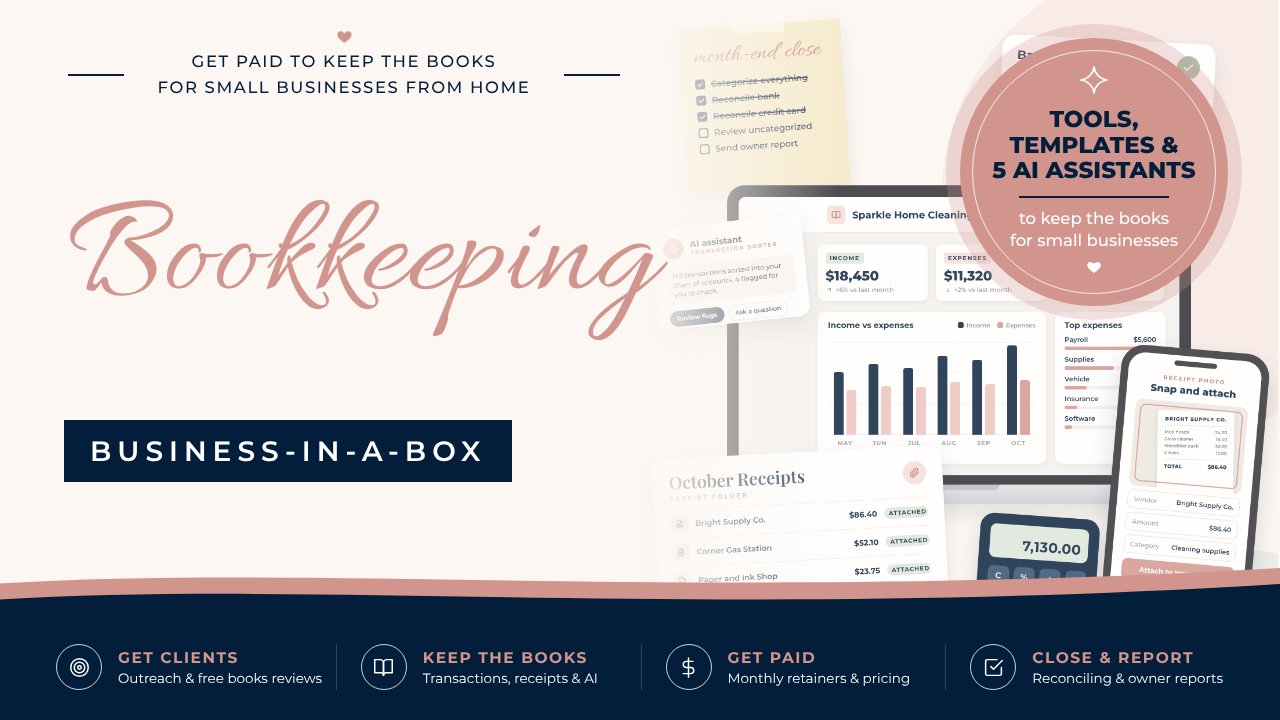
Our Bookkeeping Business-in-a-Box gives you 12 modules, 52 short written lessons, 18 templates and 5 AI assistants in Claude (Transaction Sorter, Reconciliation Helper, Report Writer, Catch-Up Planner and Client Finder), plus the AI Bookkeeping Playbook bonus with 50 AI workflows and a Month-End Procedures Pack. It’s $197, self-paced, with no videos to sit through.
How much do bookkeepers charge: FAQ
Should I charge hourly or a monthly fee?
We recommend a monthly fee based on scope. Owners like predictable costs, and you benefit when you get faster. Hourly can work for one-off help, but set a clear estimate first.
How much should a beginner bookkeeper charge?
Many beginners start at the lower end with small, simple clients, such as a Starter-style package for a solo business. Raise your prices as you gain experience, certifications and results you can honestly point to.
What if a client’s volume grows?
Put transaction and account limits in each package. When a client regularly goes over, move them up a package or add an add-on, with notice, as agreed in your engagement letter.
Do bookkeepers charge for tax preparation?
Bookkeepers don’t prepare tax returns. You can charge for preparing a year-end package of reports and documents for the client’s tax professional, who then prepares and files the return.
How many clients do I need to make $3,000 a month?
Using our example packages, 4 Starter clients at $300 plus 3 Growth clients at $600 equals $3,000 a month. Your own mix will depend on your prices and the clients you sign.
Get example bookkeeping packages and pricing
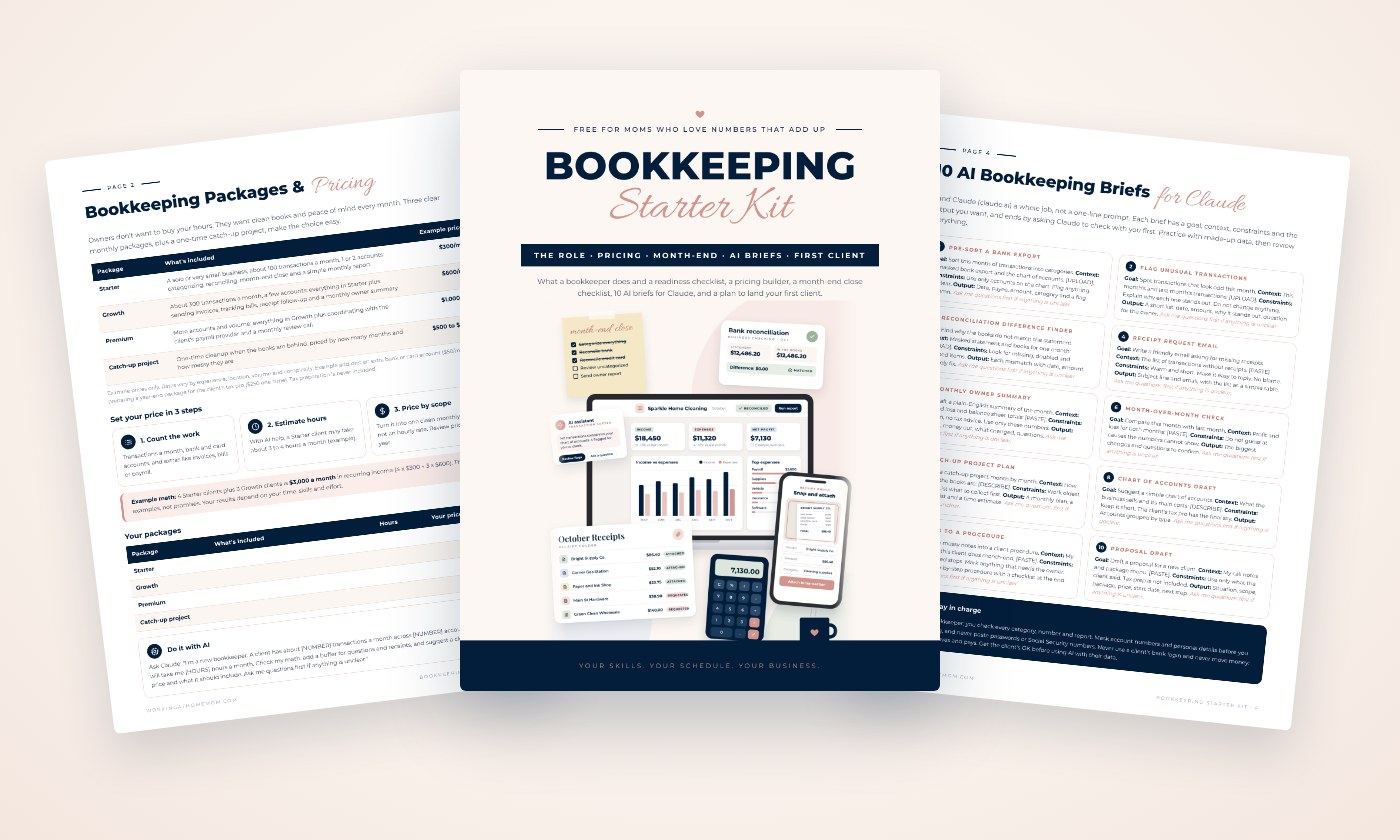
Example bookkeeping packages and pricing, a month-end close checklist, 10 ready-to-paste AI briefs and a 10-step plan to land your first client. Sent straight to your inbox.