

Pricing is the part that makes most new social media managers freeze. Charge too little and you burn out. Charge too much without a clear offer and you hear “let me think about it.” This guide covers how much to charge for social media management, using a simple process you can repeat for every client.
We won’t hand you a magic number, because there isn’t one. Rates vary widely by skill, niche and location. Instead, you’ll learn the main pricing models, how to work out your own minimum rate, and how to turn it into packages clients understand.
How much to charge for social media management: the quick answer
- Decide what you want to earn each month and what your business costs are.
- Estimate how many client hours you can realistically work.
- Divide to find your minimum hourly rate (your floor, not your price).
- Estimate the hours each package takes, multiply by your rate, then round up.
- Offer 2 or 3 monthly packages, plus a few add-ons.
- Review your prices every few months and raise them as you get faster and better.
Why there’s no single “right” rate
Two social media managers can do similar work and charge very different amounts. That’s normal. Price depends on what you deliver, who you deliver it to, and how much value the client gets from it.
So instead of searching for the going rate and copying it, start from your own numbers. Then check that your price makes sense for your clients’ size and budget.
The 4 common pricing models
1. Monthly retainer
The client pays a set amount each month for a defined scope, such as a number of posts, platforms and engagement time. This is the most popular model for ongoing social media management.
- Pros: predictable income for you, predictable cost for the client.
- Cons: scope creep if you don’t spell out exactly what’s included.
2. Per platform
You set a price for each platform you manage, then add them together. Managing Instagram might be one price, adding Facebook another.
- Pros: easy for clients to understand and scale up.
- Cons: platforms take very different amounts of work, so a flat per-platform price can hide a lot of extra hours.
3. Per post
You charge for each finished post, often with different prices for a simple graphic, a carousel or a short video.
- Pros: great for content-only clients or a trial month.
- Cons: it doesn’t cover the strategy, scheduling or engagement that make posts work.
4. Hourly
You bill for the time you spend. This can work for one-off consulting, account cleanups or clients with unpredictable needs.
- Pros: you’re paid for every minute.
- Cons: it punishes you for getting faster, and clients may watch the clock instead of the results.
Tip: even if you sell packages, keep tracking your time for the first few months. It’s the only way to know whether a package is actually profitable.
Step 1: Work out your minimum hourly rate
Your minimum rate is the lowest you can charge and still meet your goals. Here’s the simple formula:
(Monthly income goal + monthly business costs) / billable hours per month = minimum hourly rate
Billable hours are the hours you spend on client work. Remember that a good chunk of your week goes to admin, outreach and learning, which nobody pays you for directly.
Example: say your monthly income goal is $2,000 and your business costs (software, internet share, taxes set aside) are $400. You can work about 60 billable hours a month around the kids. That’s $2,400 / 60 = $40 an hour as your floor. Your numbers will be different, and that’s the point.
Step 2: How to build social media packages
Packages sell better than hourly rates because the client sees exactly what they get. To build one:
- List the tasks: planning, creating posts, writing captions, scheduling, engagement, reporting and calls.
- Estimate the time for each: be honest, and add a buffer for revisions and messages.
- Multiply by your rate: use your minimum rate or higher.
- Round up to a clean number: clients find round prices easier to say yes to.
- Write the scope clearly: what’s included, what isn’t, and how many revisions.
Example package math: Starter, Growth and Premium
The numbers below are examples to show the math, using the example $40 floor from above. They are not typical market rates. Plug in your own rate and time estimates.
Example Starter package
- What’s included: 1 platform, 12 posts a month with captions and graphics, scheduling.
- Estimated time: about 8 hours a month.
- Example math: 8 hours x $40 = $320, rounded up to $350 a month.
Example Growth package
- What’s included: 2 platforms, 16 posts a month, engagement 3 times a week, a one-page monthly report.
- Estimated time: about 15 hours a month.
- Example math: 15 hours x $40 = $600, rounded up to $650 a month.
Example Premium package
- What’s included: 3 platforms, 20 posts a month including 4 short videos, engagement on weekdays, a monthly report and a monthly strategy call.
- Estimated time: about 25 hours a month.
- Example math: 25 hours x $40 = $1,000 a month.
Your floor is not your price. These packages only cover your minimum. Once you price on the value you bring (more followers, more leads, hours saved for the owner), the same work can be worth much more. Example: the sample Growth package in our Social Media Manager course kit is $920 a month.
Notice how each tier adds clear, visible value. Most clients pick the middle option, so make it the one you most want to sell.
Add-ons to offer
- One-time account setup or refresh: bios, highlights, profile images and branding.
- Extra short videos or carousels: priced per piece.
- Event or launch coverage: a burst of extra posts around a big date.
- Rush fee: for last-minute requests outside your normal turnaround.
Do it with AI: open Claude (or ChatGPT) and paste: “I’m a social media manager. My minimum rate is [YOUR RATE] per hour. My ideal clients are [TYPE OF BUSINESS]. Help me design 3 monthly packages (Starter, Growth, Premium). For each, list the deliverables, estimate the hours for planning, creating, scheduling, engagement and reporting, and show the price math. Then suggest 3 add-ons and a short description of each package for my proposal.” Then check the hour estimates against your own experience and edit the descriptions so they sound like you.
What affects your social media management rates?
- Scope: number of platforms, posts, videos and how much engagement is included.
- Content type: short-form video usually takes much longer than a single graphic.
- Who creates the photos and video: you, or the client sending raw content.
- Your experience and results: testimonials and case studies justify higher prices.
- Niche: specialized or regulated industries may need more care and expertise.
- Client size: a solo hairstylist and a multi-location business have very different budgets and needs.
- Turnaround and availability: fast replies or weekend coverage are worth more.
- Location: local markets differ, even for remote work.
Smart pricing habits
- Keep ad spend separate: if you manage paid ads, the client pays the platform directly. Your fee is for your time and skill.
- Bill in advance: invoice at the start of each month, before the work begins.
- Set a minimum term: many managers ask for a few months up front, since results take time.
- Put it in writing: your proposal and contract should list deliverables, revisions and what costs extra.
Not sure how to lay all of this out? Our social media manager proposal template has a pricing section you can fill in.
How and when to raise your rates
Your first price is a starting point, not a life sentence. Good times to raise your rates:
- You’re fully booked: demand is higher than your time.
- You’ve added skills: video, strategy or ads.
- You have results to show: testimonials, growth in engagement or more inquiries for clients.
- It’s been 6 to 12 months: your costs go up too.
Raise prices for new clients first. For existing clients, give at least 30 days’ notice. A simple message works:
“Hi [NAME], I’ve loved working on [BUSINESS] this year. Starting [DATE], my [PACKAGE] rate will be [NEW PRICE]. Your current rate stays the same until then. I’m excited to keep growing your page, and I’m happy to chat if you have questions.”
Pricing mistakes to avoid
- Pricing by guesswork: always do the hours math first.
- Saying “unlimited”: unlimited revisions or posts will eat your evenings.
- Discounting to win every client: a client who only wants cheap often wants the most.
- Forgetting your own costs: software, taxes and time off all come out of your rate.

Price your packages with confidence
Our Social Media Manager Business-in-a-Box shows you how to build packages, write proposals and win clients. It includes 12 modules, 15 templates and 5 AI assistants to land your first social media clients.
New to all of this? Start with how to become a social media manager, then come back to set your prices.
Social media management pricing FAQ
Should I charge hourly or monthly for social media management?
Most ongoing clients prefer a monthly package because the cost is predictable. Hourly works better for one-off projects or consulting. Many managers use hourly math behind the scenes to set their monthly prices.
How much should a beginner charge for social media management?
There’s no fixed beginner rate. Work out your minimum hourly rate, estimate your hours honestly, and price from there. You can offer a short intro rate to your first clients, as long as you set a date to review it.
Does ad spend count as part of my fee?
No. Keep ad spend separate. The client should pay the ad platform directly, and your management fee covers your time and expertise.
Should I put my prices on my website?
Either can work. Showing a “starting at” price filters out clients who can’t afford you. Keeping prices for the discovery call lets you tailor the package. Many managers share a starting price and finalize it in the proposal.
How often should I raise my social media management rates?
Review your prices every 6 to 12 months, or sooner if you’re fully booked. Raise rates for new clients first, and give existing clients advance notice.
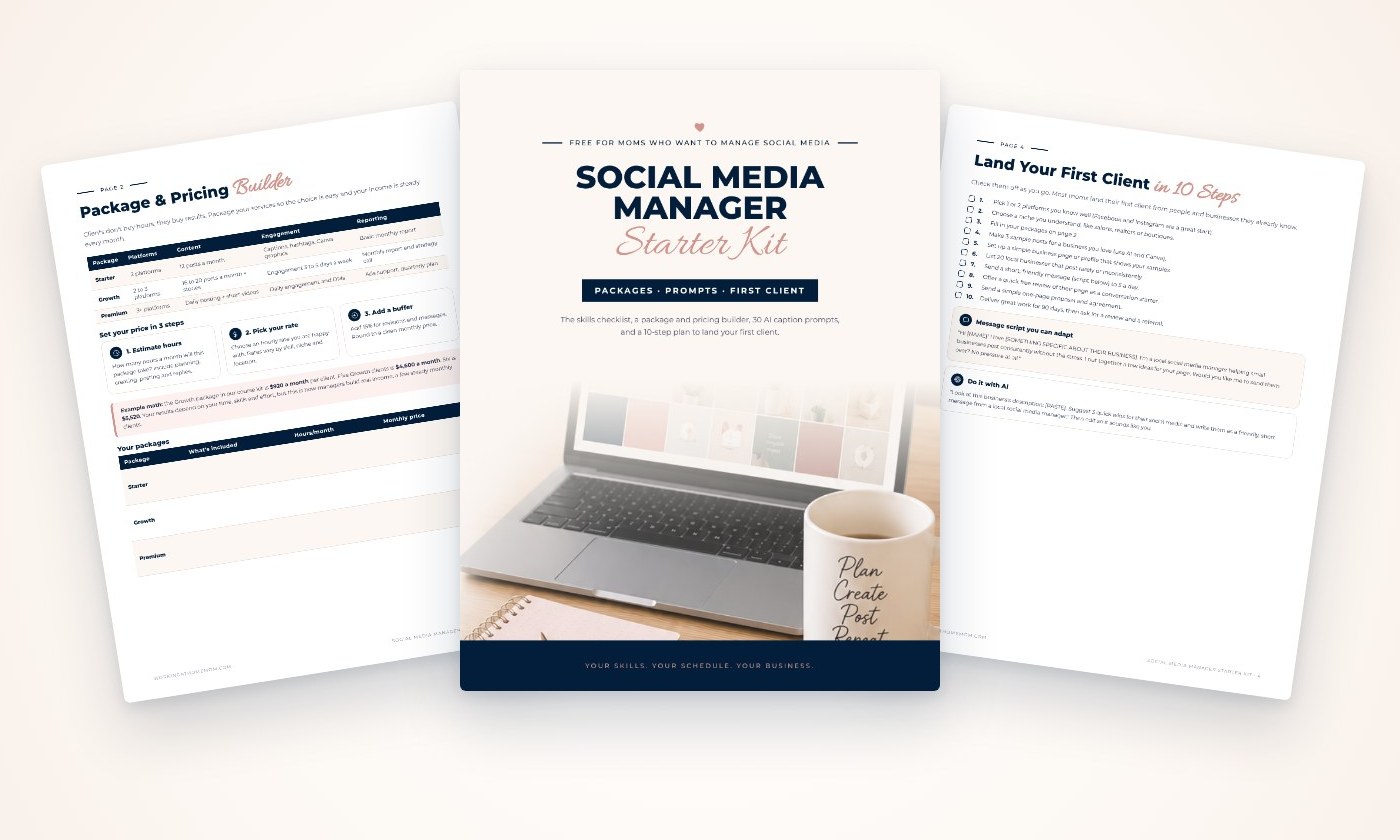
Get our free Social Media Manager Starter Kit
A package and pricing builder with real example math, 30 AI caption prompts and a 10-step plan to land your first client. Sent straight to your inbox.




