If you like writing, love a tidy plan and get a kick out of finishing things, learning how to become a funnel builder could be a great fit. A funnel builder plans and builds the pages and emails that turn a small business’s visitors into leads and paying customers.
It’s project-based work, which many moms love: no daily client inbox, clear deliverables and finished funnels for your portfolio. Monthly care plans add recurring income on top.
In this guide we walk you through each step, from the skills you need to your first paying project, with AI as your teammate so first drafts of pages, emails and even page code take minutes instead of days.
How to become a funnel builder: the quick answer
- Understand what a funnel builder does and who hires one.
- Learn the four core skills: strategy, copy, email sequences and page building.
- Pick one page builder to learn first, then adapt to each client’s tools.
- Set up Claude as your AI teammate for drafts, page code and test plans.
- Build a demo funnel for your portfolio.
- Package your services: lead magnet, sales and launch funnels, plus care plans.
- Find your first clients, starting with people you know and a free mini funnel review.
- Onboard safely, test everything and hand off a funnel that works.
What does a funnel builder do?
A sales funnel is the path a stranger takes to become a customer. They find a free offer, sign up, get a few helpful emails and then see a paid offer. If that’s new to you, our guide to what is a sales funnel explains each piece in plain English.
A funnel builder makes that path work from start to finish:
- Plan: get clear on the offer, the audience and the steps, then map the funnel on one page.
- Write: draft the opt-in page, thank-you page and sales page copy.
- Email: write the welcome or sales sequence that turns subscribers into buyers.
- Build: create the pages in the client’s page builder, on desktop and mobile.
- Connect: set up forms, tags, checkout and the automations that send the right email at the right time.
- Test and launch: check every link, form and email, then help the client go live and improve from there.
Who hires funnel builders?
Funnel clients are usually small businesses that sell something online or want more inquiries. Common examples are coaches, course creators, consultants, wellness pros, local service businesses and small online shops.
Signs a business needs a funnel builder:
- No way to capture leads: people visit the website or social profile, then leave without a trace.
- A freebie nobody sees: they made a checklist or guide, but there’s no proper opt-in page or follow-up.
- Launches done by hand: every launch is a scramble of manual emails and payment links.
- Tech overwhelm: the owner can’t face the pages, forms and automations.
What they’re really buying is more leads and sales without doing the tech themselves.
Step 1: Learn the four core funnel skills
1. Funnel strategy
Before building, get clear on who the offer is for, the problem, the promise, the price and the proof the client really has. Then pick the funnel type and sketch every page, email, tag and goal on one page. A funnel map saves hours of rework.
2. Copywriting
Good funnel copy is clear, not clever. Learn benefit-led headlines, short opt-in pages with one call to action, and the classic sales page order: problem, promise, what’s inside, who it’s for, proof, price and FAQ. Every claim must be true and match what the client actually offers.
3. Email sequences
Emails do the selling in most funnels. Start with a welcome sequence (delivery, quick win, story, value, soft offer), then learn sales and launch sequences. You’ll also need basic email rules awareness: people must opt in, and every marketing email needs an unsubscribe link and the sender’s business address. Rules vary by country, so suggest clients check their local requirements.
4. Page building and tech
Learn how pages are built from sections, rows, columns and elements, and how to make them work on a phone. Then learn the plumbing: forms, tags, checkout and simple automations such as “form submitted, add tag, send delivery email”. Most builders are drag and drop, so no coding is needed.
Step 2: Pick your tools (and stay flexible)
Learn one page builder well first. We use Bonidi, the all-in-one system we use for funnels, websites, forms, email, payments and automations. Once you understand one builder, the skills transfer.
Your clients may already use other tools, such as ClickFunnels, Kajabi, Systeme.io, Leadpages, WordPress or Shopify, with email in tools like Flodesk or Kit. Payments run through the client’s own Stripe or PayPal account. Use the client’s existing tools first whenever they work. Moving a business to a new platform is a project in itself.
Tip: you don’t need to master every platform before you start. Say yes to clients on tools you know, and learn new builders one project at a time with their help pages open.
Step 3: Set up your AI teammate
This is where today’s funnel builders work much faster. Instead of asking AI for one headline at a time, hand it whole jobs: turn a discovery-call transcript into an offer summary and funnel map, draft a full sales page from the client’s worksheet, or write a 5-email sequence in the client’s voice.
The secret is a good brief. Give Claude the goal, the context, examples, your constraints and the output you want, and ask it to ask you questions first if anything is unclear. We walk through the full method in how to use AI to build sales funnels.
Do it with AI: paste this into Claude: “Goal: turn this discovery call into a funnel plan. Context: my client is [TYPE OF BUSINESS] selling [OFFER] at [PRICE] to [AUDIENCE]. Constraints: use only facts from the transcript, and flag anything missing instead of guessing. Output: a one-paragraph offer summary, a short audience profile, the funnel type you recommend and a funnel map listing each page, email, tag and goal in order. Ask me questions first if anything is unclear. Transcript: [PASTE TRANSCRIPT].” Then check every detail against what the client said and edit it before you share it.
One rule from day one: get each client’s OK before using AI with their information, and never paste passwords, card numbers, bank details or API keys into any AI tool.
Step 4: Build a demo funnel for your portfolio
Clients want to see what you can do. You can show them before your first paid project:
- Invent a small business: for example, a yoga teacher offering a free 7-day morning routine checklist.
- Build a lead magnet funnel end to end: opt-in page, thank-you page, a 3-email welcome sequence, a form and a tag.
- Test it properly: sign up as a fresh contact and check every email arrives and every link works.
- Write it up: a few screenshots plus a short note on your choices and what you’d test next. Label it clearly as a demo.
Then offer one project at a friendly price to a real business you know, in exchange for a case study. Never invent results or testimonials.
Step 5: Package and price your services
Funnel builders usually charge per project, with an optional monthly care plan afterward. Here are the example packages we teach, to give you a starting point:
- Example lead magnet funnel, $500 to $750: opt-in page, thank-you or delivery page, a 3-email welcome sequence, form and tag setup, and testing.
- Example sales funnel, $1,500: sales page, checkout or order page, thank-you page, a 5-email sales sequence, automation and testing.
- Example launch funnel, $2,500: waitlist page, sales page, checkout, a launch sequence of about 8 to 10 emails, cart-close reminders and launch-week support.
- Example care plan, $300/month: small edits, a monthly check that every form, link and email still works, one test or improvement and a short numbers report.
Example: 2 sales funnels a month plus 4 care plans = $4,200 a month (2 x $1,500 + 4 x $300). Rates vary by experience, niche and location, and your results depend on your time, skills and effort. For add-ons and how to set your own prices, read how much do funnel builders charge.
Step 6: Find your first funnel clients
Start with the people who already know you: friends, past coworkers and local business owners. Many first clients come from “I know someone who needs that”.
Next, look where small business owners spend time:
- Coaches and course creators online: many have a freebie with no real funnel behind it.
- Local service businesses: a simple quote-request funnel can bring a cleaning company or salon more inquiries.
- LinkedIn and Facebook groups: share helpful tips and follow each group’s rules about promotion.
- Other freelancers: VAs, social media managers and designers often need a funnel partner. If you’re one already (see how to become a virtual assistant or how to become a social media manager), funnels are a natural add-on.
- Upwork: follow the platform’s rules and lead with your demo funnel.
A free mini funnel review is a friendly way to start a conversation: three quick, specific suggestions for a prospect’s opt-in page.
Do it with AI: ask Claude: “Here is the text of a small business’s opt-in page: [PASTE PAGE TEXT]. The business is [TYPE OF BUSINESS] and the page offers [FREEBIE]. Give me three specific, kind suggestions to improve it (headline, bullets, button or form), each in one or two sentences. Then write a short, friendly message under 150 words sharing those three ideas and offering a 20-minute call. No hype and no pressure. Ask me questions first if anything is unclear.” Then check each suggestion makes sense and edit the message so it sounds like you.
Step 7: Onboard, build, test and hand off
Before you start, put a simple service agreement in place covering scope, revisions, timeline, deposit and payment terms, who owns what after payment, access and data, and how you use AI. This is general awareness, not legal advice, so check local rules or ask a professional.
Get access through each tool’s user or collaborator settings and a password manager, never shared logins. The client connects their own payment account, so you never need their bank or card details.
Then build, and test everything before launch with a fresh test contact: links, forms, emails, mobile views, checkout in test mode, tags and automations. Finish with a short walkthrough doc or Loom video showing where everything lives, and offer the care plan so the funnel keeps working.
What a sales funnel project can look like
Here’s an example four-week timeline for a sales funnel once you have your templates and AI assistants set up:
- Week 1: discovery call, offer summary and funnel map. Claude drafts both from your notes; you check them.
- Week 2: sales page copy and the 5-email sequence. AI writes first drafts; you edit for the client’s voice and for truth.
- Week 3: build the pages, connect checkout and set up the automations.
- Week 4: full test, client review, fixes and launch.
Because the work comes in clear blocks, it fits around school hours more easily than on-call work.
Build your first funnel with five AI assistants
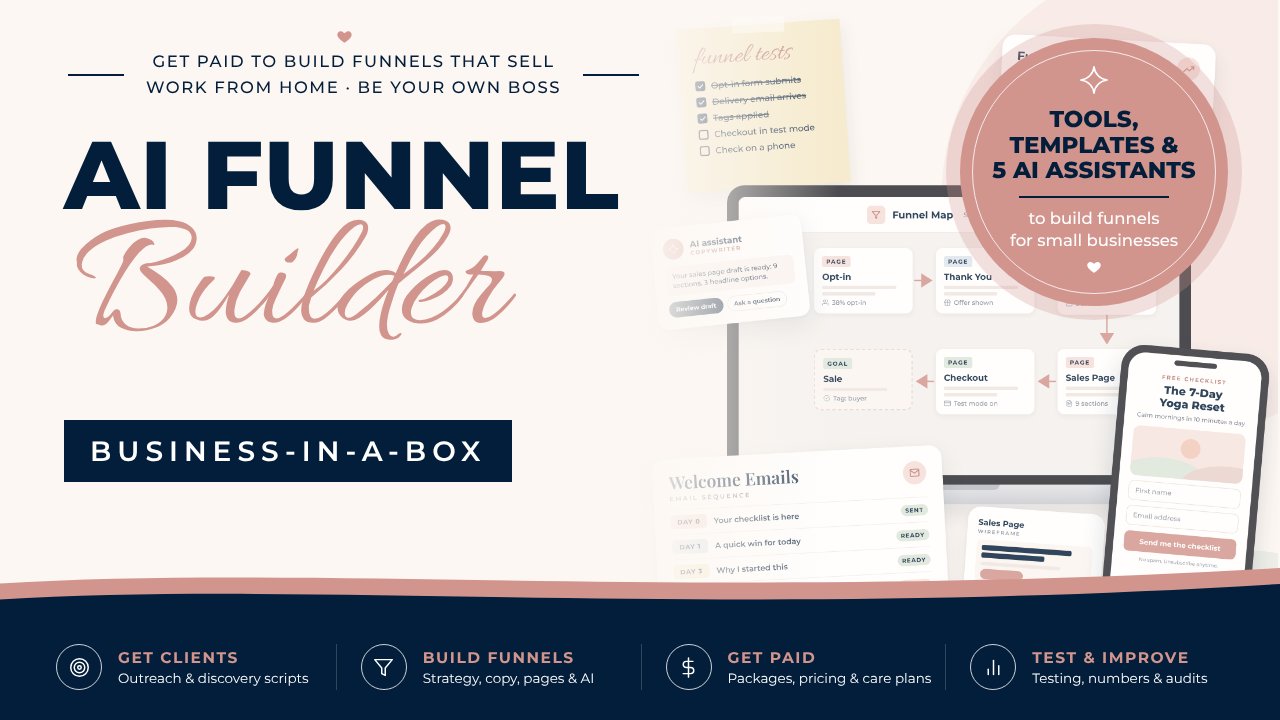
Our AI Funnel Builder Business-in-a-Box gives you 12 modules, 52 short written lessons, 18 templates and 5 AI assistants in Claude (Funnel Strategist, Copywriter, Email Writer, Page Builder Helper and Client Finder), plus the AI Funnel Playbook bonus with 50 AI workflows and a swipe file of 10 page outlines. It’s $197, self-paced, with no videos to sit through.
How to become a funnel builder: FAQ
Do I need tech or coding skills to become a funnel builder?
No. Most page builders are drag and drop, and you’ll learn forms, tags and automations step by step. When you need a small piece of custom code, AI can write it, and you test it on a draft page first.
Do I need a certification?
No. There’s no required license. Clients care whether you can deliver a funnel that works, so a demo funnel and honest case studies matter most.
Can a VA or social media manager become a funnel builder?
Yes, and it’s a natural move. You already know small business owners and their tools, so funnel building can start as an add-on service for clients who trust you.
How long does it take to build a funnel?
It depends on the funnel and how quickly the client gives feedback. As an example, a lead magnet funnel might take a week or two and a sales funnel about four weeks, including writing, building and testing.
Will AI replace funnel builders?
AI is excellent at first drafts, but it doesn’t understand a client’s business, check facts, test a checkout or own the result. Funnel builders who use AI well simply deliver faster. You stay the editor and the one responsible.
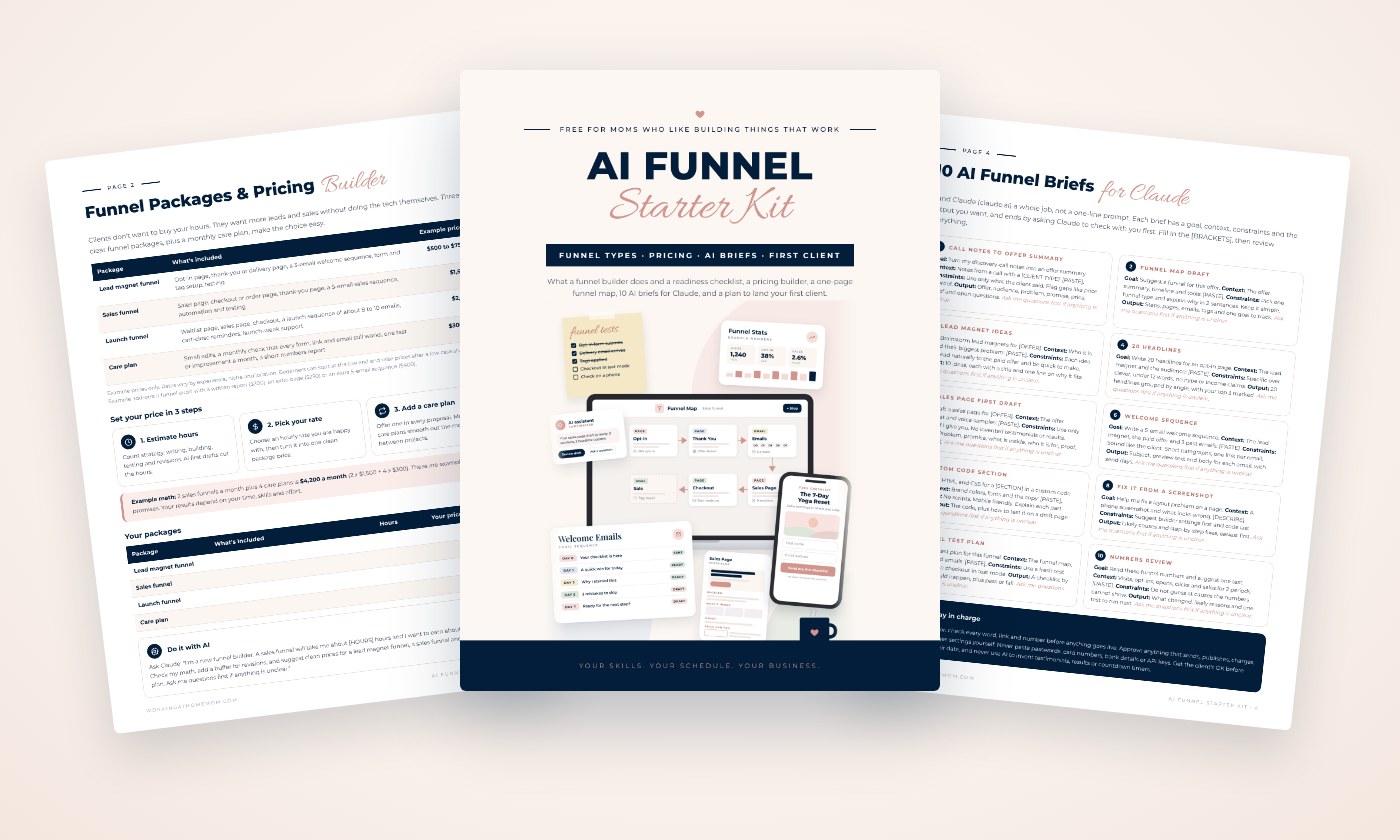
Start your funnel builder business this week
Example funnel packages and pricing, a one-page funnel map, 10 ready-to-paste AI briefs for funnel copy and emails, and a 10-step plan to land your first client. Sent straight to your inbox.