

If you’re a virtual assistant who keeps hearing “can you just handle this?”, or an organized mom who loves a good plan, learning how to become an online business manager could be your next big step. An online business manager (OBM) runs the day-to-day operations of an online business so the owner can focus on the big picture.
Instead of doing tasks for lots of clients, an OBM manages projects, systems, a small team and the numbers for 1 to 3 clients, usually on a monthly retainer. It’s more responsibility, and it’s usually better paid.
In this guide we walk you through each step, including the most common way in: growing from VA to OBM. We also show you how to use AI like a teammate, so the first drafts of plans, SOPs and reports take minutes instead of hours.
How to become an online business manager: the quick answer
- Understand what an OBM does: running operations, not just doing tasks.
- Build a foundation as a VA or in an office, admin or project role.
- Learn the five core skills: project management, SOPs and systems, team management, metrics and reporting, and tools and automation.
- Set up Claude as your AI teammate for plans, SOPs and reports.
- Package your services as monthly retainers.
- Practice on your own business or a current client and build proof.
- Pitch your current VA clients first, then your network.
- Onboard each client safely and nail your first 30 days.
What does an online business manager do?
Think of an OBM as the owner’s right hand. The owner sets the vision and makes the big decisions. You make sure the plan actually happens, on time, with the right people doing the right work.
- Projects: planning launches and big projects, breaking them into tasks, assigning owners and keeping deadlines on track.
- Systems: writing and maintaining SOPs (standard operating procedures) so work gets done the same way every time.
- Team: hiring, onboarding and checking in with contractors like VAs, designers and editors.
- Metrics: tracking a handful of key numbers and sending the owner a weekly report.
- Tools: keeping the tech stack tidy and automating repeat work.
- Weekly rhythm: running the planning, check-ins and wrap-ups that keep the business moving.
A VA usually asks “what do you need me to do?” An OBM asks “what needs to happen this month, and who’s doing it?” We break the differences down fully in online business manager vs virtual assistant.
Who hires online business managers?
OBM clients are usually online businesses that have grown past the “owner does everything” stage. Common examples are course creators, coaches, small agencies, online shops and service businesses with a small team of contractors.
Signs a business needs an OBM:
- The owner is the bottleneck: the team waits on answers, and projects stall when the owner is busy.
- Launches feel chaotic: every launch is a last-minute scramble.
- Nothing is written down: how things work lives in the owner’s head.
- Nobody watches the numbers: the owner can’t say how leads or sales are trending.
- Too many tools: logins everywhere, overlapping apps and nobody sure what’s used.
Step 1: Build your foundation (the VA-to-OBM path)
Most OBMs grow into the role. The skills come from doing the work and noticing how a business really runs.
If you’re already a VA
You may be closer than you think. You’re probably ready to start moving toward OBM work if:
- Other contractors come to you: the designer or editor asks you what’s next.
- You already write processes: you’ve documented how to do recurring tasks.
- You spot problems early: you notice missed deadlines or broken handoffs before the owner does.
- You suggest improvements: you’d rather fix the system than redo the task.
The easiest first OBM client is often a VA client who already trusts you. More on that in Step 6.
If you’re not a VA yet
Start with VA work. It’s the best training ground for OBM work because you see the inside of real businesses. Our guide on how to become a virtual assistant shows you how to begin. Office, admin, project coordination or team lead experience also counts, so list it.
Step 2: Learn the five core OBM skills
1. Project management
You’ll manage work in a project tool like ClickUp, Asana, Trello or Notion. Learn the basics: projects, tasks, statuses, owners, due dates and recurring tasks. Always use the client’s existing tool first if it works. Moving a team to a new tool is a project in itself.
2. SOPs and systems
An SOP is a short, clear set of steps for a task, like publishing a blog post or onboarding a new client. OBMs audit how work gets done, find repeated work and missing steps, and build an SOP library the team can actually follow.
3. Team management
You’ll help write role descriptions and job posts, run a paid trial task, onboard new contractors and hold weekly check-ins. Whether someone is a contractor or an employee is a legal question, so we suggest checking your local rules or asking a professional.
4. Metrics and reporting
Pick 5 to 8 numbers that matter for each client, such as revenue, leads, conversion, delivery and team capacity. Track them weekly and send a short owner report: wins, numbers, risks, decisions needed and next week’s priorities.
5. Tools and automation
List every tool the business uses, what it does, who owns it and where tools overlap. Then automate small, repeat jobs like form follow-ups and onboarding reminders with tools like Zapier or Bonidi workflows. Start small and test everything.
Step 3: Set up your AI teammate
This is where today’s OBMs work much faster. Instead of asking AI for one sentence at a time, hand it whole jobs: turn messy meeting notes into a project plan, draft an SOP from a rough description, or write the first draft of the weekly report from the numbers.
The secret is a good brief. Give Claude the goal, the context, an example, your constraints, the output you want, and ask it to ask you questions first if anything is unclear. We walk through the full method in AI for virtual assistants and online business managers.
Do it with AI: paste this into Claude: “Goal: turn these meeting notes into a project plan. Context: I’m the online business manager for [TYPE OF BUSINESS] with a team of [ROLES]. The project is [PROJECT] and it must be done by [DATE]. Constraints: no task longer than one week, each task has one owner. Output: a table with task, owner, due date and dependency, then a list of open questions. Ask me questions first if anything is unclear. Notes: [PASTE NOTES].” Then check every date and owner and edit it before you share it with the team.
One rule from day one: get each client’s OK before using AI with their information, and never paste passwords, card numbers, bank details or government IDs into any AI tool.
Step 4: Package your OBM services
OBMs usually work on monthly retainers: a set scope of work for a set monthly fee. Here are the example packages we teach, to give you a starting point:
- Example Essentials, $1,200/month: weekly operations check-in, project management in the client’s tool, task and deadline tracking, and a monthly report.
- Example Growth, $2,000/month: everything in Essentials plus team management (up to about 3 contractors), SOP building and a weekly owner report with KPIs.
- Example Partner, $3,000/month: everything in Growth plus launch and big-project management, tech and automation improvements, and a monthly strategy session.
Example: 2 Growth clients = $4,000/month, and 3 Growth clients = $6,000/month. Rates vary by experience, niche and location, and your results depend on your time, skills and effort. For add-ons and how to set your own prices, read how much do online business managers make.
Step 5: Practice and build proof
Clients want to see how you think. You can build that proof before your first OBM client:
- Run your own business like a client: write SOPs for your own processes and keep a simple weekly plan.
- Make sample deliverables: a sample project plan, a sample SOP and a sample weekly owner report with made-up numbers, clearly labelled as samples.
- Document real wins: if you’ve improved a process for a VA client, write a short before-and-after summary (with their permission and without private details).
Never invent results or testimonials. Honest samples and real examples are more convincing anyway.
Step 6: Land your first OBM client
Start with the people who already know your work. If you’re a VA, pitch one current client on “more of what I already do for you”: taking over the weekly planning, managing the other contractors and sending a weekly report.
Do it with AI: ask Claude: “I’m a VA for [CLIENT TYPE]. I currently do [TASKS]. I’ve noticed [2 OR 3 PROBLEMS YOU’VE SEEN, SUCH AS MISSED DEADLINES OR NO SOPS]. Write a short, friendly email offering to step into an online business manager role on a monthly retainer, focused on how it frees up their time. Keep it under 200 words and end with a suggestion for a 20-minute call. Ask me questions first if anything is unclear.” Then edit it so it sounds like you before you send it.
Next, tell your network, post about your services on LinkedIn, join online business communities where course creators and coaches spend time, and check job boards like Upwork (always follow each platform’s rules). Offering a free mini ops review, three quick wins for their business, is a friendly way to start a conversation. Our list of where to find virtual assistant clients covers many of the same places.
Step 7: Onboard safely and nail the first 30 days
Before you start, put a simple service agreement in place covering scope, payment terms, confidentiality, data and access, how you use AI, and how either side can end the contract. This is general awareness, not legal advice, so check local rules or ask a professional.
Get access the safe way: through a password manager and each tool’s shared or delegated access, never shared logins. Ask only for the access you need.
Then use your first 30 days to build trust:
- Week 1: kickoff call, access set up, and a few quick wins.
- Week 2: an operations audit to find bottlenecks and missing systems.
- Week 3: your first weekly owner report and a priority list.
- Week 4: the weekly rhythm in place: Monday planning, midweek check, Friday wrap-up.
What a week as an OBM can look like
Here’s an example week with two clients once your systems are set up:
- Monday: review last week, plan this week’s priorities, and send each team its tasks. Claude drafts the plan from your notes.
- Tuesday and Wednesday: project time, SOP writing and solving problems.
- Thursday: team check-ins and follow-ups on anything stuck.
- Friday: update the KPI sheet, review Claude’s draft of the owner report, edit it and send it.
Learn the whole OBM role, with AI doing the first drafts
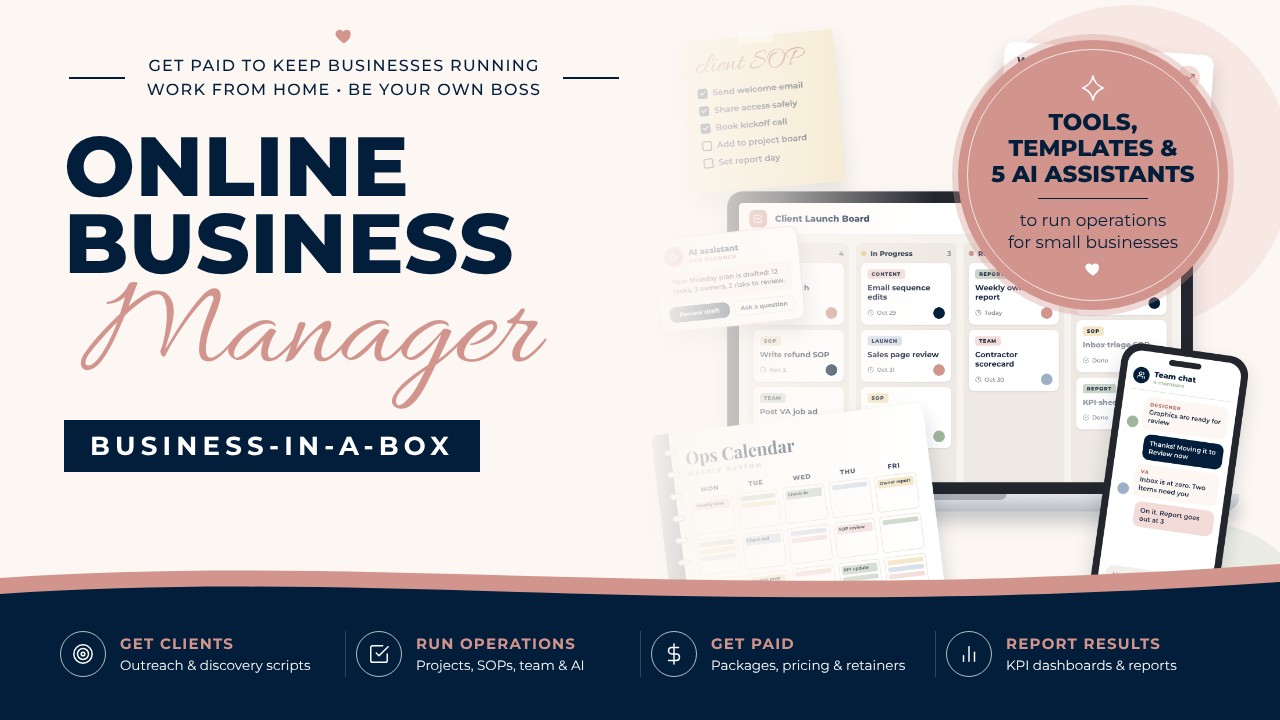
Our Online Business Manager Business-in-a-Box gives you 12 modules, 52 short written lessons, 18 templates and 5 AI assistants in Claude (Ops Planner, SOP Writer, Team and Hiring Helper, Report Writer and Client Finder), plus the AI Ops Playbook bonus with 50 AI workflows. It’s $197, self-paced, with no videos to sit through.
How to become an online business manager: FAQ
Do I need a certification to become an online business manager?
No. There’s no required license or certification. Clients care about whether you can run projects, keep a team on track and communicate clearly. Training helps you learn faster and feel confident, but proof of your skills matters most.
Can I become an OBM without being a VA first?
Yes, if you have related experience, like office management, project coordination or running a team. Many OBMs come from VA work because they’ve already seen how online businesses operate from the inside.
How long does it take to move from VA to OBM?
It depends on your experience and how quickly you build the core skills. Some VAs grow into the role with an existing client over a few months by gradually taking on planning, team coordination and reporting.
How many clients does an online business manager have?
Usually 1 to 3. OBM work is deeper than VA work, so you take on fewer clients and give each one more attention and responsibility.
Will AI replace online business managers?
AI is excellent at first drafts, summaries and organizing information, but it doesn’t own outcomes, build trust with a team or make judgment calls for a client. OBMs who use AI well simply get more done. You stay the editor and the one responsible.
Start your move from VA to OBM this week
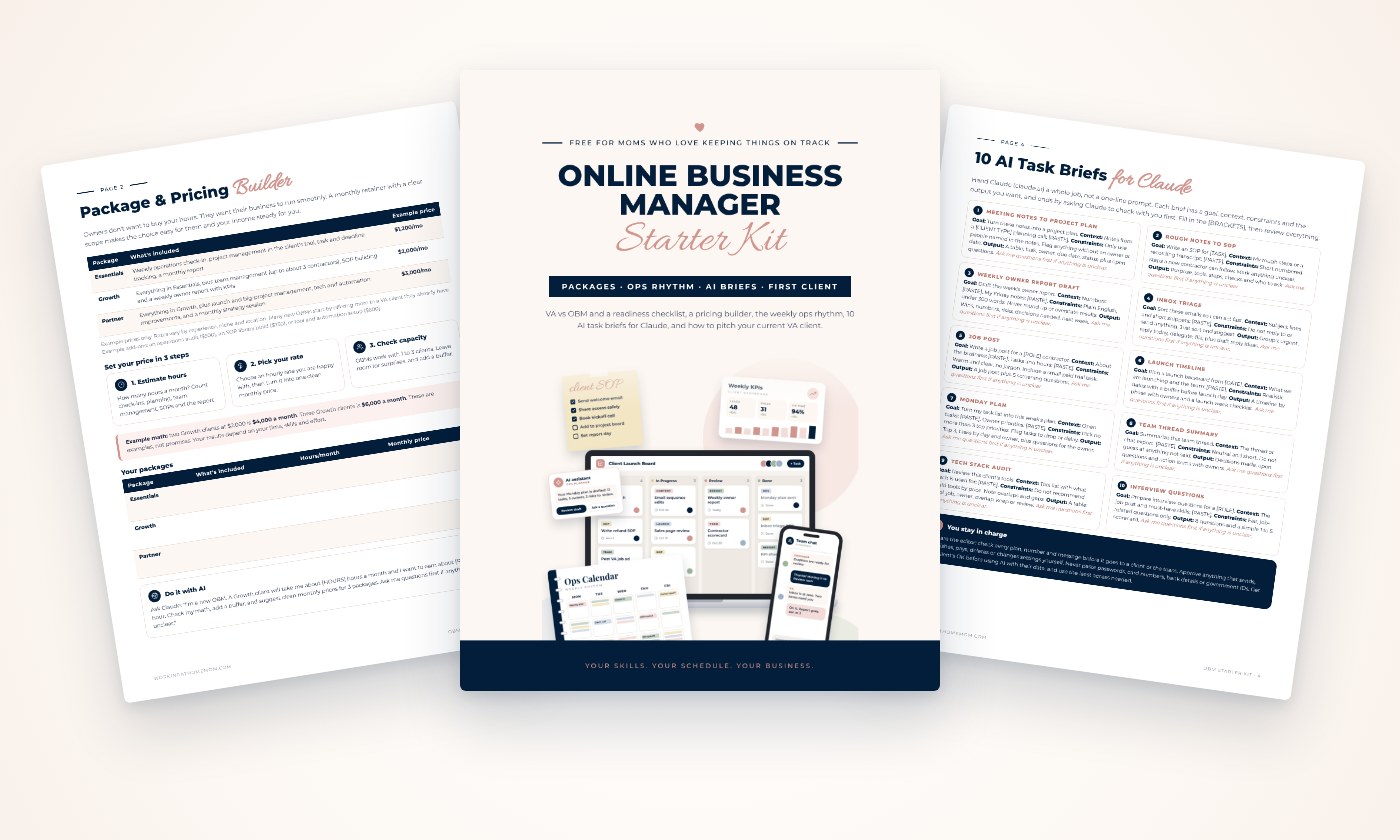
Example OBM packages and pricing, a one-page weekly ops rhythm, 10 ready-to-paste AI task briefs and a script to pitch your current VA clients. Sent straight to your inbox.





