Live chat jobs from home are a good fit for moms who’d rather type than talk on the phone. Instead of taking calls, you answer customers in the chat window on a company’s website or app, helping with orders, accounts, bookings and tech questions.
Chat work is quieter than phone support, which many parents love. But it’s still a real customer service job, usually with set shifts, metrics and several conversations happening at once. It’s also a favorite disguise for scammers. This guide covers what the work is, the skills you need, honest pay, where to find legit openings and how to stay safe.
Live chat jobs from home: the quick answer
- What it is: typed customer support for a company, often handling 2 or more chats at once.
- Pay: similar to phone customer service, often around $14 to $17 an hour at entry level; rates vary.
- Key skills: fast, accurate typing, clear writing and the ability to juggle conversations.
- You’ll need: a computer (not a phone), reliable internet and a distraction-free space.
- Where to look: customer service outsourcing companies, brand career pages and trusted job boards.
- Red flags: interviews only by text or messaging app, paying for equipment and fake checks.
What a live chat agent does (and a realistic day)
A live chat agent (also called a chat support specialist or chat associate) answers customer questions in real time by typing. Typical tasks include:
- Answering product and order questions: shipping, returns, sizing, refunds.
- Account help: password resets, billing questions and updating details.
- Basic tech support: walking customers through simple fixes step by step.
- Escalating: passing tricky issues to a supervisor or another team with clear notes.
- Logging: tagging and documenting every conversation in the company’s system.
In 2026, many companies use AI chatbots for simple questions, so human agents often get the conversations that need judgment: upset customers, complicated orders and anything the bot couldn’t solve. That makes empathy and clear writing even more important.
A realistic shift might look like this:
- Start of shift: log in, read team updates and check any new policies.
- Main block: handle a steady stream of chats, often two or three at a time, using saved replies you personalize.
- Breaks: taken at scheduled times, not whenever you like.
- End of shift: finish open chats, add notes and log out.
Who chat jobs suit (and who they don’t)
A good fit if you
- Write clearly and kindly: you can explain things simply in a friendly tone.
- Type fast and accurately: customers notice slow or sloppy replies.
- Like a quiet workday: no phone calls, though you still need focus.
- Can stay organized under pressure: keeping track of several customers at once.
Not a good fit if you
- Expect to chat from your phone: almost all chat support roles require a computer and company software.
- Need to step away often: customers are waiting in real time, so interruptions are hard.
- Get stressed by metrics: response time, resolution and customer ratings are usually tracked.
Looking for something you can truly do on your phone? See our list of jobs you can do from your phone instead.
Honest pay for live chat jobs
Chat support usually pays about the same as phone customer service. Entry-level roles commonly pay around $14 to $17 an hour, with rates varying by company, state, shift and specialty. Bilingual and technical chat roles may pay more.
Example: working 20 hours a week at $15 an hour comes to about $300 a week before taxes, or roughly $1,300 a month. This is example math, not a promise. Some roles are seasonal, and some are contractor positions where you cover your own taxes and expenses. Check your local rules or talk to a tax professional.
Be very skeptical of listings that promise much higher pay for “easy chatting” with no experience. That’s one of the most common scam hooks.
Skills and equipment
Skills that get you hired
- Typing speed and accuracy: many employers give a typing test. Practice with free online typing tests until you’re consistently fast with few errors.
- Clear, professional writing: good grammar and a warm tone, without slang.
- Multitasking: switching between chats, a knowledge base and an order system without mixing up customers.
- Empathy in writing: showing you understand, even when you can’t give the customer what they want.
Equipment
- Computer: a laptop or desktop that meets the company’s requirements. Some provide equipment to employees; others don’t.
- Internet: reliable high-speed internet, and some companies require a wired connection.
- Workspace: a quiet spot where you can concentrate. Chat roles may be more forgiving about background noise than phone roles, but focus still matters.
- A second monitor: not always required, but it makes juggling chats much easier.
Tip: keep a notepad next to you with each customer’s name and issue while you juggle chats. It’s an easy way to avoid sending the wrong reply to the wrong person.
Step by step: how to get a live chat job
- Test your typing: take a few online typing tests and note your average speed and accuracy.
- Update your resume: highlight written communication, customer-facing work and any experience juggling tasks, like retail, front desk work, volunteering or managing a busy household calendar.
- Search with the right words: “chat support,” “chat agent,” “live chat customer service,” “email and chat support” and “customer support specialist remote.”
- Filter by your state: many remote roles are open only in certain states or countries.
- Read the whole listing: confirm it’s chat-only or a mix of chat, email and phone. Many roles blend all three.
- Prepare for a writing assessment: you may be asked to answer sample customer messages. Use a friendly greeting, a clear answer and a polite close.
- Interview on video or phone: legit companies usually use real interviews, not chat-only “interviews” on messaging apps.
A simple chat reply formula
Use this structure in assessments and on the job: “Hi [NAME], thanks for reaching out. I’m sorry your [ORDER OR ISSUE] isn’t right. I’ve [ACTION YOU TOOK], and you’ll see [WHAT HAPPENS NEXT] by [TIME]. Is there anything else I can help with today?”
Do it with AI: paste this into Claude or ChatGPT: “Act as a customer contacting [TYPE OF COMPANY, for example an online clothing store] through live chat. Play three different customers one at a time: one confused, one upset about a late order and one asking for a refund outside the return window. Send one message at a time and wait for my reply. After each conversation, give me feedback on my tone, clarity and speed, and suggest a better version of my weakest reply.” Then review the feedback with your own judgment, and keep practicing until your replies feel natural and kind.
Where to find legit live chat jobs
Chat openings change constantly, so always check the company’s official careers page and recent employee reviews before applying.
- Customer experience outsourcing companies: large firms such as Concentrix, TTEC, Foundever and Alorica hire remote agents for many brands, including chat and email roles.
- Brands that hire directly: retailers, software companies, travel companies and banks sometimes post work-from-home chat support roles on their own sites.
- Contractor platforms: some companies connect independent contractors to chat and phone support programs. These can be more flexible but may require you to cover equipment, background checks or unpaid certification time. Read the terms first.
- Job boards: Indeed and FlexJobs both have remote live chat and chat support listings you can filter.
Chat work pairs well with other typing-based jobs. Compare legit online data entry jobs and work-from-home jobs for moms with no experience to widen your search.
Live chat job scams and red flags
- “Interviews” over text, Telegram or WhatsApp: a common scam is a fake recruiter who interviews you entirely by chat, then sends an offer.
- Equipment payments or checks: you’re asked to buy equipment from their vendor, or to deposit a check and send some back. The check bounces later.
- Paying for training or a “starter kit”: legitimate employers don’t charge you to get hired.
- “Chat moderator” gigs with vague details: some listings that promise easy pay for chatting are scams or involve content you may not want to be part of. Know exactly what you’ll be doing and for which company.
- Task or “rating” jobs: pay for liking, rating or “boosting” products that later asks you to deposit money to unlock earnings is a scam.
- Early requests for sensitive details: don’t send your Social Security number, ID or bank information until you’ve verified the company and received an official offer.
When in doubt, stop replying and look for the job yourself on the company’s official website.
Your first-week plan
- Day 1: take 3 typing tests and record your average. Check your computer and internet.
- Day 2: update your resume to highlight writing and customer service.
- Day 3: set up job alerts for “chat support” and “live chat” roles on Indeed and FlexJobs, filtered by your state.
- Day 4: practice with the AI role-play prompt above for 20 minutes.
- Day 5: apply to 3 to 5 roles that match your schedule.
- Day 6: write 5 saved replies you could adapt (greeting, apology, refund, escalation, closing).
- Day 7: plan childcare for a possible training period and apply to a few more roles.
Prefer to set your own hours?
Chat jobs build exactly the skills small business owners look for in a virtual assistant: clear writing, fast replies and staying organized. If you’d like to choose your own clients and schedule, read how to become a virtual assistant.
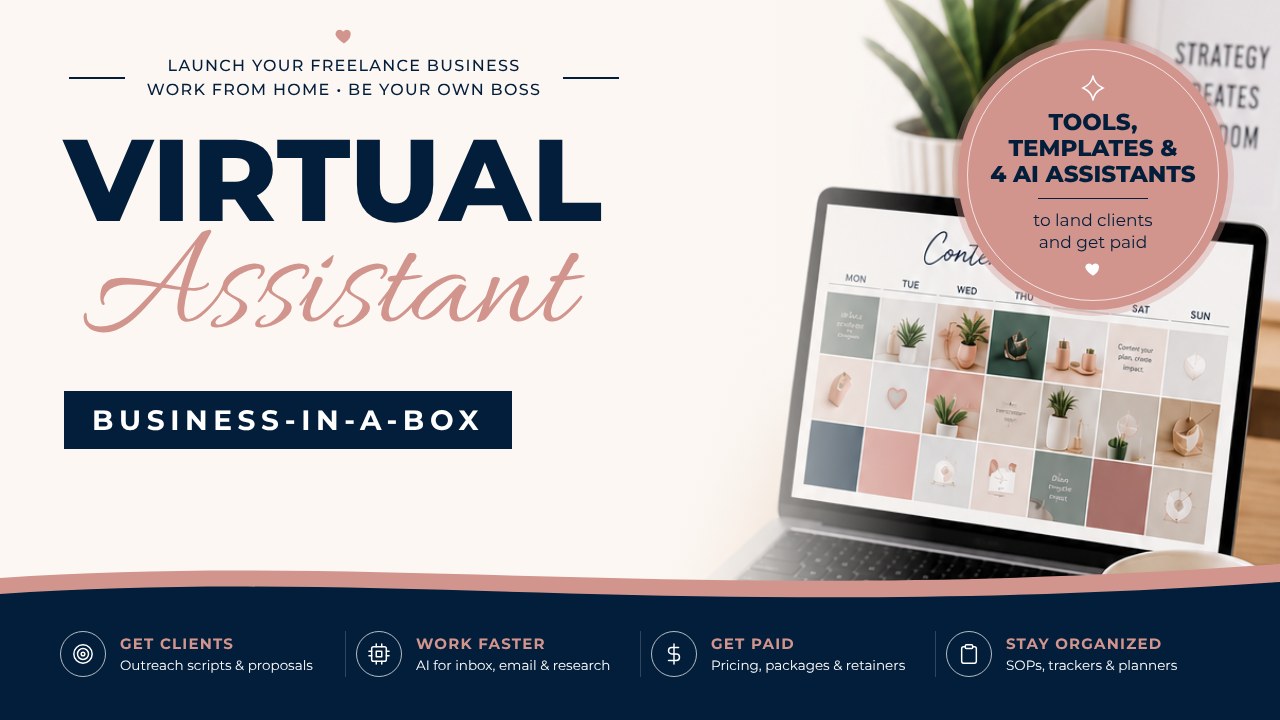
Use your chat skills to build a VA business
Our Virtual Assistant Business-in-a-Box covers services, pricing, clients and AI for the daily work, with 12 modules, 19 templates and 4 AI assistants. It’s self-paced, so you can build it around your family.
Live chat jobs FAQ
Are live chat jobs from home legit?
Many are. Real chat support jobs are posted on company career pages and trusted job boards, include real interviews and never ask you to pay. Be cautious with offers that come by text or messaging app.
How fast do I need to type for a chat job?
Requirements vary by employer. Accuracy matters as much as speed, so practice until you can type quickly with very few errors, and check each listing for its stated requirement.
Can I do live chat jobs on my phone?
Almost never. Most chat support roles require a computer, company software and sometimes a wired internet connection.
How much do chat agents make?
Pay is similar to phone customer service, often around $14 to $17 an hour at entry level. Bilingual or technical roles may pay more, and rates vary by company and location.
Do chat jobs need experience?
Many entry-level roles don’t, and they offer paid training. Retail, food service, reception and volunteer work all count as customer service experience.
Turn your typing skills into client work
Get our free VA Services & Rates Cheat Sheet with simple, ready-to-use ideas to help you get started.