

Medical billing and coding from home is one of the most advertised work-from-home careers out there. It’s a real field with real remote jobs, and healthcare always needs people who can turn patient visits into accurate codes and paid claims.
But the ads leave out the hard parts. You need genuine training, usually a professional certification, and most fully remote roles want experience first. Many people start in an office or hybrid role and move to remote work later.
This guide explains what each job involves, who it suits, how to train and certify the right way, how to get from beginner to remote and which programs and offers to avoid.
Medical billing and coding from home: the quick answer
- Coding turns medical records into standard codes. Billing uses those codes to get claims paid.
- Expect months of real training in anatomy, medical terminology and code sets.
- Most employers want a recognized credential, such as AAPC’s CPC or AHIMA’s CCA or CCS.
- Most remote roles ask for experience, so many people start on site or in a hybrid role.
- Skip programs that promise fast certification, guaranteed jobs or “be your own boss” billing businesses.
Medical billing vs. medical coding: what’s the difference?
The two jobs are related and often taught together, but they’re different work.
- Medical coders read patient records (doctor’s notes, procedures, test results) and assign standard codes for diagnoses and services. In the US, that mainly means ICD-10-CM for diagnoses, CPT for procedures and services and HCPCS Level II for certain supplies and services. Accuracy matters because codes drive payment and compliance.
- Medical billers use those codes to create and send claims to insurance companies and government programs, follow up on denials, post payments, answer patient billing questions and work on unpaid accounts.
In small practices, one person may do both. In larger organizations and billing companies, they’re usually separate roles, and remote work is more common for experienced coders and for certain billing and revenue cycle roles.
A realistic day
Say you’re a remote coder for a clinic. You log in to a secure system, open a queue of patient encounters, read each provider’s notes and assign codes. When documentation is unclear, you send a query to the provider rather than guessing. You’re measured on accuracy and productivity, and your work is audited.
As a remote biller, your day might be checking claims for errors before submission, working through a list of denied claims, calling or messaging insurance companies and documenting every step.
Who it suits (and who it doesn’t)
It can be a good fit if you:
- Love detail and rules: coding guidelines are extensive and change regularly.
- Are comfortable with medical language or eager to learn it.
- Like steady, structured work with clear right and wrong answers.
- Want a long-term career with room to specialize (for example in a medical specialty, auditing or compliance).
It’s probably not a fit if you:
- Need income in the next few weeks: training and getting experience take time.
- Want to work in tiny scattered blocks: remote roles often have productivity targets, set hours or both.
- Don’t have a private workspace: patient privacy rules require it.
- Dislike ongoing study: credentials usually require continuing education to stay active.
Honest pay: check real data, not ads
Schools and ads often quote big numbers. We won’t, because pay depends on your credential, specialty, experience, employer and location, and beginners usually earn less than the figures you see advertised.
For realistic numbers, check the US Bureau of Labor Statistics Occupational Outlook Handbook, which covers this work under “Medical Records Specialists,” and compare it with actual job listings in your state that match your experience level. Look at whether a listing is hourly or salaried, full or part time and whether it includes benefits.
Tip: before you pay for any program, search job boards for “remote medical coder” and read 20 listings. Write down which credentials and how many years of experience they ask for. That’s your real roadmap.
Training and certification: what’s actually required
There’s no single license for medical coding, but in practice most employers want formal training and a recognized credential. The best-known options include:
- AAPC Certified Professional Coder (CPC): widely requested for physician office and outpatient coding.
- AAPC Certified Professional Biller (CPB): focused on billing and the claims process.
- AHIMA Certified Coding Associate (CCA): an entry-level coding credential.
- AHIMA Certified Coding Specialist (CCS): a more advanced credential, often linked to hospital coding.
- NHA Certified Billing and Coding Specialist (CBCS): a combined billing and coding credential.
One detail many people miss: with AAPC, new CPC or CPB holders who don’t yet have work experience typically carry an apprentice designation until they meet AAPC’s requirements to remove it, which involves documented experience or approved training. Some employers prefer candidates without it. Check AAPC’s current rules for details.
Choosing a training program
- Start with the credential: pick the credential your target jobs ask for, then choose training that prepares you for that exam.
- Look at community colleges: many offer billing and coding certificates, sometimes with financial aid.
- Check credibility: ask whether the program is accredited or approved by the credentialing body, what its exam pass rates are and whether it includes practice coding or an externship.
- Compare total cost: include books, code manuals, exam fees, memberships and renewals. Check current pricing for each.
- Ask about job help honestly: career support is fine. A job guarantee is a red flag.
HIPAA and privacy: non-negotiable at home
Billing and coding staff handle protected health information every day. US privacy law, including HIPAA, and your employer’s policies set strict rules for how it’s handled. At home, that usually means:
- A private workspace where family members can’t see your screen or hear calls.
- A secure computer and connection, often employer-provided, not shared with kids.
- Locking your screen every time you step away.
- No printing, photographing or saving patient information outside approved systems.
- No pasting patient information into AI tools or personal apps unless your employer has approved that tool for this use.
This is general awareness, not legal advice. Your employer’s training and policies are what you follow.
How to get from beginner to remote
- Research job listings in your area. Note required credentials, experience and whether roles are remote, hybrid or on site.
- Choose a credential and a credible program. Plan for several months of study alongside family life.
- Study for and pass the exam. Use practice exams and timed practice with code books or approved resources.
- Get your first healthcare job. Patient registration, front desk, insurance verification, charge entry, billing office and hospital records roles are common stepping stones, and many are on site.
- Build accuracy and a track record. Ask for coding or billing tasks, learn your employer’s systems and keep your continuing education current.
- Move to hybrid or remote. Many employers allow remote work once you’ve proven yourself, or you can apply for remote roles with your experience.
- Consider specializing. Specialties, auditing and denials management can open more remote options over time.
Do it with AI: use AI to plan, not to code real patient records. Paste this into Claude or ChatGPT: “I want to work in medical billing and coding from home. I live in [STATE], can study [HOURS] hours a week and my background is [BACKGROUND]. Here are requirements from 5 real job listings: [PASTE REQUIREMENTS]. Create a step-by-step 12-month plan that covers which credential to target, what to study each month, what entry-level jobs to apply for and questions to ask training programs. Point out anything I should verify with the credentialing organization.” Then check every credential detail on the official AAPC, AHIMA or NHA site, since requirements change.
Where to find legit medical billing and coding jobs
- Large job boards: Indeed, LinkedIn and FlexJobs list billing, coding and revenue cycle roles. Filter by remote and hybrid, and read requirements carefully.
- Health systems and hospitals: check the careers pages of hospitals and clinics in your area. Many hire on site first and allow remote work later.
- Billing and coding companies: outsourcing and revenue cycle companies often hire experienced remote coders and billers.
- Professional organizations: AAPC and AHIMA run job boards and local or online chapters where members share openings.
While you train, you might look at steadier entry points too. Our guide to remote jobs for work-from-home beginners includes customer support and admin roles, and online data entry jobs that are legit and hiring covers detail-focused work you can start sooner.
Scams and red flags
- “Get certified in weeks” promises: real credentials take serious study, and some have eligibility or experience components.
- Job or income guarantees: no legitimate school can guarantee you a job, let alone a remote one.
- Medical billing “business opportunities”: offers to sell you software, training and a list of doctor clients so you can run billing from home. The FTC has long warned that many of these don’t deliver clients and leave buyers with losses.
- Certificates that aren’t credentials: a program’s own “certificate of completion” is not the same as passing an exam from a recognized credentialing body.
- Jobs that ask you to pay: for equipment, software or “background checks” before hiring.
- Offers by text or messaging app with no real interview.
Your first-week plan
- Day 1: read the BLS overview for medical records specialists and 20 real job listings. Note the credentials and experience they want.
- Day 2: read the credential pages on the AAPC, AHIMA and NHA websites and pick the one your target jobs ask for most.
- Day 3: list three training options, including a community college, and write down your questions about accreditation, pass rates and externships.
- Day 4: try a free intro to medical terminology to see if you enjoy it.
- Day 5: contact your top programs with your questions and compare the total costs.
- Days 6 and 7: build your 12-month plan with the AI prompt above, including when you’ll apply for a first healthcare role.
If you like numbers but need a faster start
If the training timeline doesn’t fit right now, small business bookkeeping uses some of the same strengths (accuracy, tidy records and following rules) and can often be started sooner with client work you schedule yourself. Our guide on how to become a bookkeeper from home explains the path.
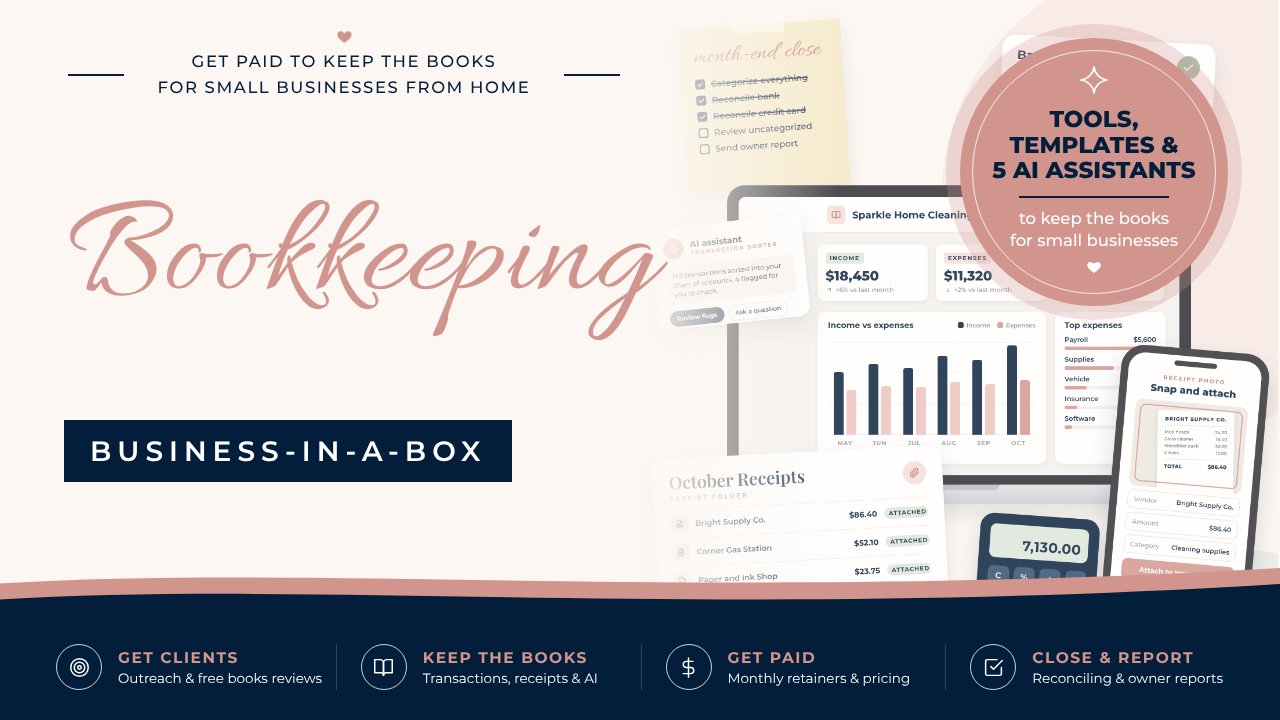
Like numbers and tidy records? Try bookkeeping
Our Bookkeeping Business-in-a-Box shows you how to keep the monthly books for small businesses with AI doing the heavy lifting, with 12 modules, 18 templates and 5 AI assistants. It’s $197 and self-paced.
Medical billing and coding from home FAQ
Can I do medical billing and coding from home with no experience?
It’s possible but uncommon. Most remote roles ask for a credential and experience. Many people start in an on-site or hybrid healthcare job, then move to remote work once they’ve built a track record.
How long does it take to become a medical coder?
Many training programs take several months to a year or more, depending on the program and how much time you can study. Then you’ll need to pass a credentialing exam and build experience.
Which certification is best for medical coding?
It depends on where you want to work. The CPC is common for physician office and outpatient roles, while the CCS is often linked to hospital coding. Check what local job listings ask for before you choose.
How much do medical billers and coders make?
Pay varies by credential, specialty, experience, employer and location. Check the Bureau of Labor Statistics data for medical records specialists and compare it with real job listings near you, rather than relying on school ads.
Is AI replacing medical coders?
AI and computer-assisted coding tools are changing the work, and some routine tasks are increasingly automated. Human coders still review, audit and handle complex cases, so accuracy, specialty knowledge and comfort with these tools are becoming more important.
Explore a numbers-based business you can start sooner
Get our free Bookkeeping Starter Kit with simple, ready-to-use resources to help you see if small business bookkeeping fits you.





