

When moms ask us about the most profitable things to sell online, they usually mean “What will actually leave money in my pocket?” That’s a different question from “What sells the most?” A product can sell every day and still earn you almost nothing once you pay for materials, shipping and platform fees.
In this guide we compare the main types of products you can sell from home by profit margin, with simple example math for each. By the end you’ll know how to work out your own numbers before you spend a dollar on stock.
What are the most profitable things to sell online? The quick answer
- Digital products (printables, templates, planners): the highest margins, often most of the sale price, because there’s no product cost.
- Resale and thrift flips: strong margins per item when you buy low, but each find takes time.
- Handmade goods: healthy margins on materials, limited by how many you can make.
- Wholesale products: moderate margins, more cash tied up in stock.
- Print on demand: the lowest margins per item, but no inventory and no shipping work.
Profit vs revenue: the numbers that matter
Before comparing products, here are the three numbers worth knowing:
- Revenue: the price the customer pays.
- Profit per sale: revenue minus everything it costs you to make that sale: product or materials, packaging, shipping you cover, and platform and payment fees.
- Profit margin: profit per sale divided by the price, shown as a percentage. A $10 sale with $7 profit is a 70% margin.
Platform fees vary by where you sell and change over time, so always check the current fees for Etsy, Shopify, Bonidi or wherever you sell. In the examples below we use a made-up “fees” figure so you can see how the math works. Swap in your real numbers.
Profit margin examples by product type
1. Digital products: the highest margins
Printables, digital planners, Canva templates, spreadsheets and patterns cost you time to make, but nothing to “produce” each time they sell. The buyer downloads a file, so there’s no material, packaging or shipping cost.
Example: a printable budget bundle sells for $10. Say fees come to $1.50 in this example. Product cost is $0. Profit is $8.50, an 85% margin.
The catch: competition is high and low prices are common, so you need a clear niche and lots of listings. Our guide to the best things to sell online from home covers the effort and pros and cons of each type.
2. Resale and thrift flips: big margins, one item at a time
Buying clothing, kids’ gear, books or home decor at thrift stores, yard sales or clearance racks and reselling it online can produce large margins on each item.
Example: you buy a brand-name kids’ winter coat for $8 and sell it for $40. Say fees are $5 and packaging is $2 (the buyer pays shipping). Profit is $25, about a 63% margin.
The catch: every item is a one-off. You spend time sourcing, photographing and listing each piece, and you can’t sell the same coat twice.
3. Handmade goods: healthy margins, limited by your hours
Candles, jewelry, crochet, soap and sewn items let you set premium prices because they’re made by you.
Example: a soy candle sells for $24. Materials are $6, packaging is $2, and say fees are $3 (the buyer pays shipping). Profit is $13, about a 54% margin.
The catch: you’re the factory. If you can make three candles an hour, your profit is about $39 per hour of making, before the time you spend on photos, listings and packing.
4. Wholesale products: moderate margins, more cash up front
Buying products in bulk from suppliers and selling them under your shop name is how many boutiques work.
Example: you buy a set of reusable snack bags for $6 each wholesale and sell them for $18. Say fees are $2.50 and packaging is $1. Profit is $8.50, about a 47% margin.
The catch: you pay for stock before you sell it, and anything that doesn’t sell is money sitting on a shelf. Our guide on where to buy products to sell online explains how to source carefully.
5. Print on demand: lowest margins, least hassle
With print on demand, you upload designs and a service like Printful or Printify prints and ships each order. You never touch inventory.
Example: a T-shirt sells for $28. Say your print provider charges $16 for the shirt plus shipping, and fees are $3.50. Profit is $8.50, about a 30% margin.
The catch: the provider takes the biggest slice of each sale, so you need more sales to earn the same profit. The upside is that you can test lots of designs with almost no risk. Check your provider’s current pricing, since base costs change.
The most profitable things to sell online, side by side
| Product type | Example price | Example profit | Example margin | Biggest limit |
|---|---|---|---|---|
| Digital product | $10 | $8.50 | 85% | Competition, needs volume |
| Resale item | $40 | $25 | 63% | One-off items, sourcing time |
| Handmade candle | $24 | $13 | 54% | Your making hours |
| Wholesale item | $18 | $8.50 | 47% | Cash tied up in stock |
| Print on demand | $28 | $8.50 | 30% | Thin margin per sale |
All figures are hypothetical examples to show the math, not typical results.
Margin isn’t everything: think profit per month
A high margin on a cheap item can still mean small profits. What really matters is how much you keep each month for the hours you put in. Let’s say your goal is $2,000 a month in profit. Using the examples above:
- Digital products: $2,000 / $8.50 = about 236 sales a month, or roughly 8 a day across all your listings. No extra work per sale.
- Resale: $2,000 / $25 = 80 items a month, about 20 a week to source, photograph, list and ship.
- Handmade candles: $2,000 / $13 = about 154 candles, or around 51 hours of making, plus packing and shipping.
- Wholesale: $2,000 / $8.50 = about 236 sales, and you’d need to buy that stock first.
- Print on demand: $2,000 / $8.50 = about 236 sales, with no packing or shipping on your side.
That’s why many moms start with digital products or print on demand (low risk, no shipping) and add a higher-ticket handmade or resale line once they know what their buyers love. Results depend on your time, skills and effort, but running these numbers first keeps you from building a busy shop that barely pays.
Do it with AI: open Claude (or ChatGPT) and paste: “Help me work out profit margins for my online shop. Product: [PRODUCT]. Price: [PRICE]. Cost per item: [MATERIALS OR WHOLESALE COST]. Packaging: [COST]. Shipping I pay: [COST]. Platform and payment fees: [YOUR REAL FEES FROM THE PLATFORM’S FEE PAGE]. Show profit per sale, margin as a percentage, how many sales I need for [MONTHLY GOAL] a month, and 3 ways to improve the margin.” Then double-check the math yourself before you set prices.
How to raise your profit margins
- Bundle products: a bundle of five printables or a candle gift set raises the order value while fees and packaging barely change.
- Price for value, not cost: look at what similar products sell for and what makes yours better. Underpricing is the most common margin killer.
- Cut per-order costs: buy packaging and materials in bulk once you know what sells.
- Add an upsell: offer a matching add-on, like a coordinating tag with a candle or a bonus page with a planner.
- Sell on your own store too: your own store gives you more control over pricing and lets you build an email list. Our Etsy vs Shopify comparison explains the trade-offs, and Bonidi is the all-in-one system we use.
Tip: keep a simple spreadsheet with one row per product: price, cost, fees, profit and margin. Update it whenever a supplier or platform changes its prices. Five minutes a month can save you from selling at a loss.
Pick profitable products and launch your shop
Online Shop Business-in-a-Box shows you how to pick products, set up your store in Bonidi or Shopify, sell on Etsy too, and launch, with templates and AI assistants to help you price for profit from day one.
Profitable things to sell online FAQ
What has the highest profit margin to sell online?
Digital products usually have the highest margins because there’s no material or shipping cost each time they sell. Your main costs are your time to make them and platform fees.
What is a good profit margin for an online shop?
It depends on what you sell. Digital products can keep most of the sale price, while print on demand and wholesale usually keep much less. Work out your own numbers and make sure each sale is worth your time.
Is print on demand profitable?
It can be, but the margin per item is thinner because the provider covers printing and shipping. It works best with good designs, a clear niche and enough volume.
Is it more profitable to make or resell products?
Making products, especially digital ones, often gives higher margins. Reselling can earn more per item but takes sourcing time and only sells once. Many sellers do a mix.
How do I calculate profit on an online sale?
Take the sale price, then subtract product or material cost, packaging, any shipping you pay, and platform and payment fees. Divide the profit by the price to get your margin.
Plan, price and launch your shop
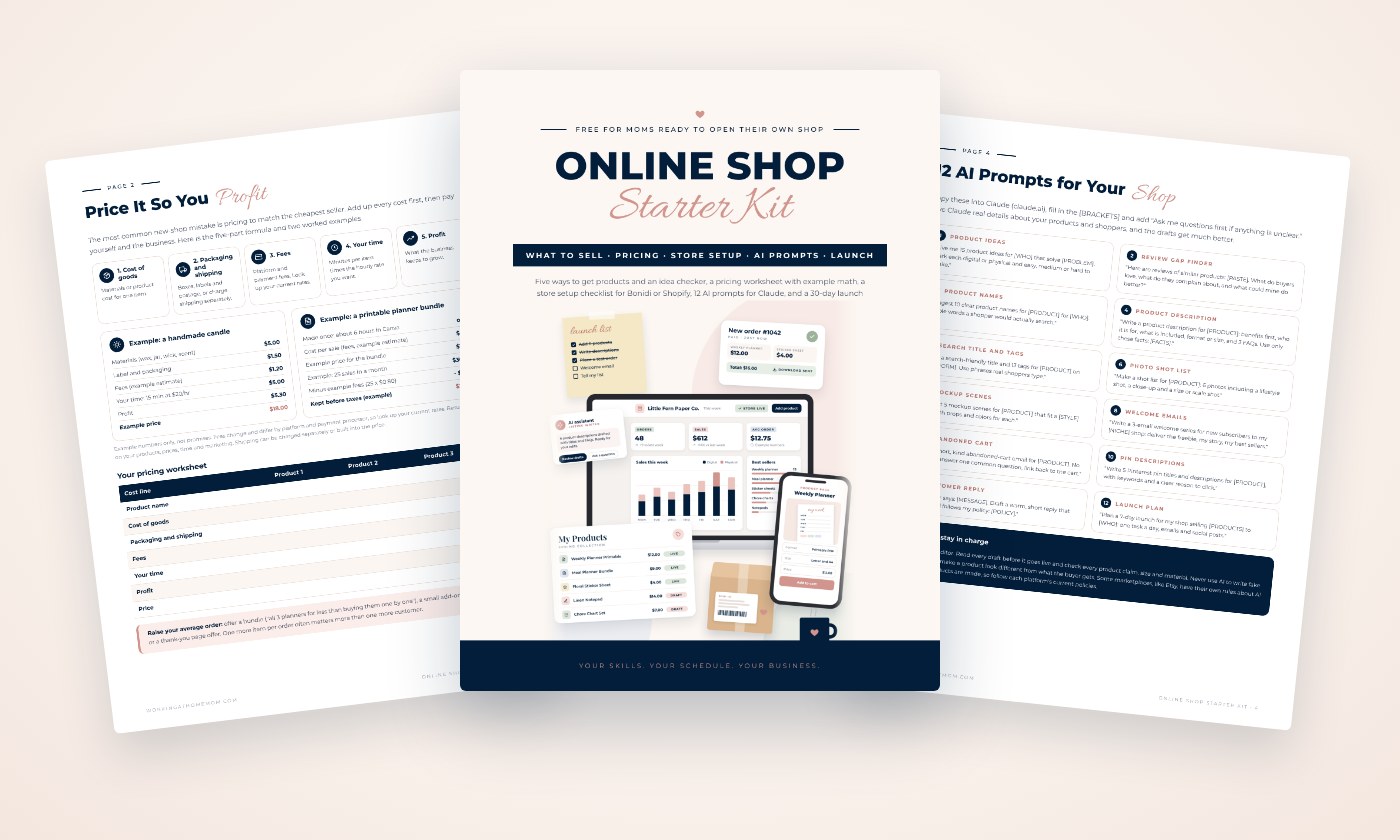
Five ways to get products, a pricing worksheet with example math, a store setup checklist for Bonidi or Shopify, 12 AI prompts and a 30-day launch plan. Sent straight to your inbox.





