

If you’ve been looking at online business manager vs virtual assistant roles, you’ve probably noticed they sound similar. Both support online business owners from home, both use many of the same tools, and many OBMs started out as VAs. But the day-to-day work, the clients and the way you get paid are quite different.
In short, a virtual assistant does tasks. An online business manager runs operations. In this guide we compare the two side by side and help you figure out which one fits you right now, and when you might be ready to move up.
Online business manager vs virtual assistant: the quick answer
- The work: a VA completes tasks; an OBM plans the work, manages the team and owns the systems.
- Clients: a VA often has several clients; an OBM usually has 1 to 3.
- Pay: VAs often charge hourly or by task package; OBMs usually charge monthly retainers.
- Skills: VAs need reliability and tool skills; OBMs add project management, leadership, systems and reporting.
- AI: VAs use AI to do tasks faster; OBMs use AI to run whole workflows like plans, SOPs and reports.
What does a virtual assistant do?
A virtual assistant provides remote support with specific tasks. The client (or their OBM) decides what needs doing, and the VA gets it done well and on time.
- Admin: inbox management, calendar scheduling, data entry and document formatting.
- Customer support: answering emails and messages from customers.
- Content tasks: uploading blog posts, scheduling social posts, formatting newsletters.
- Research: finding information, comparing options and summarizing it.
For a full menu of services, see our virtual assistant services list.
What does an online business manager do?
An online business manager runs the operations side of the business. The owner focuses on vision, content, clients and sales. The OBM makes sure everything behind the scenes works.
- Project management: planning launches and projects, assigning tasks and keeping deadlines on track.
- Systems: auditing how work gets done and building an SOP library.
- Team management: hiring, onboarding and managing contractors, often including VAs.
- Metrics: tracking key numbers and sending the owner a weekly report.
- Tools: keeping the tech stack tidy and automating repeat work.
Our step-by-step guide on how to become an online business manager covers each skill in more detail.
The key differences between an OBM and a VA
1. The work: tasks vs outcomes
A VA is given a task list. An OBM is given a goal, like “launch the new program by March”, and works out the task list, who does each part and how to keep it on track. VAs are responsible for doing the work well. OBMs are responsible for the result.
2. Clients: many vs a few
Because VA work is task-based, many VAs support several clients at once, a few hours each. OBM work is deeper. You learn one business inside out, attend team meetings and handle problems as they come up, so most OBMs work with 1 to 3 clients.
3. Pay structure: hourly vs retainers
VAs often charge by the hour or sell packages of hours or tasks. Rates vary widely by skill, niche and location; our guide on how much a virtual assistant should charge covers the options.
OBMs usually charge a monthly retainer: a set fee for a defined scope, paid every month. You’re paid for running operations, not for counting hours. Example: a Growth package at $2,000/month covers team management for up to about 3 contractors, SOP building and a weekly owner report. With 2 Growth clients that’s $4,000/month, and with 3 it’s $6,000/month. These are example figures only; we break down all three example packages in how much do online business managers make.
4. Skills: execution vs leadership
Great VAs are reliable, detail-focused and good with tools. OBMs need those skills too, plus:
- Planning: breaking big goals into milestones and tasks.
- Leadership: giving clear direction and feedback to contractors.
- Systems thinking: spotting why something keeps going wrong and fixing the process.
- Numbers: reading a simple KPI sheet and explaining what changed.
- Confident communication: telling the owner what’s at risk and what decisions are needed.
5. The relationship: helper vs right hand
A VA supports the owner. An OBM partners with the owner. You’ll be in planning conversations, you’ll push back when a deadline isn’t realistic, and you’ll often be the person the team comes to first.
6. How each uses AI
Both roles get a big boost from AI tools like Claude, but in different ways. A VA might use Claude to draft an email reply, summarize a document or tidy a spreadsheet. An OBM hands Claude whole jobs: turning meeting notes into a project plan, drafting SOPs from a transcript or writing the weekly owner report from the numbers. In both roles, you review and approve everything before it reaches the client or team. Our guide to AI for virtual assistants and online business managers shows you how.
Same client, two roles: an example
Say a course creator with a team of three is preparing a new program launch. Here’s how the work might split:
- The VA: uploads lessons, schedules the launch emails, answers customer questions and updates the calendar.
- The OBM: builds the launch timeline backward from the date, assigns tasks to the VA, designer and copywriter, runs a daily check-in during launch week, keeps an issues log and sends the owner a debrief with numbers and lessons learned.
Both roles matter. The OBM just sits one level up, making sure all the pieces fit together.
Which one is right for you?
VA work might suit you better right now if you’re new to online work, want clear tasks, prefer several smaller clients or have only a few hours a week. It’s a great way to learn how online businesses operate. If you’re not working as a VA yet, our Virtual Assistant Business-in-a-Box is the place to start.
OBM work might suit you better if you love planning, enjoy guiding people, care about the bigger picture and want deeper work with fewer clients.
How to know when you’re ready to move from VA to OBM
Look for these signs in your current work:
- You’re already managing people: other contractors check with you before the owner.
- You think in systems: you’ve written SOPs or checklists without being asked.
- You see problems coming: you notice a deadline slipping before anyone says so.
- You want ownership: you’d rather plan the launch than just schedule the emails.
- Clients ask for more: they keep asking you to “just handle” bigger things.
- You’re comfortable with numbers: you can track a few KPIs and explain them simply.
If you checked four or more, you’re likely ready to start taking on OBM work. If you checked fewer, that’s fine. Keep building skills in your VA work and revisit the list in a few months.
Do it with AI: paste this into Claude: “I’m a virtual assistant thinking about becoming an online business manager. Here’s everything I’ve done for clients in the last month: [PASTE YOUR TASK LIST]. Sort these into ‘task work’ and ‘operations work’ (planning, team, systems, reporting, tools). Then tell me which of the five OBM skill areas I’m strongest in, which I’m missing, and suggest one small way to practice each missing skill with my current clients. Ask me questions first if anything is unclear.” Then check its suggestions against what you actually enjoy and what your clients need.
How to make the move
You don’t have to quit VA work overnight. Most people transition gradually:
- Pick one client: choose a VA client who trusts you and has a small team.
- Offer a project first: an operations audit (example price $500) to find bottlenecks and missing systems is a low-risk way to show OBM thinking.
- Propose a retainer: based on what the audit finds, suggest an OBM package that takes over planning, team coordination and reporting.
- Hand off task work: as you take on OBM clients, phase out or delegate task-only work.
Tip: can you be both? Yes, for a while. Many people run a hybrid business during the switch. Just be clear in each agreement which role you’re playing, so scope and price match the work.
Your results depend on your time, skills and effort, but the path is clear: build skills, prove them with one client, then grow.
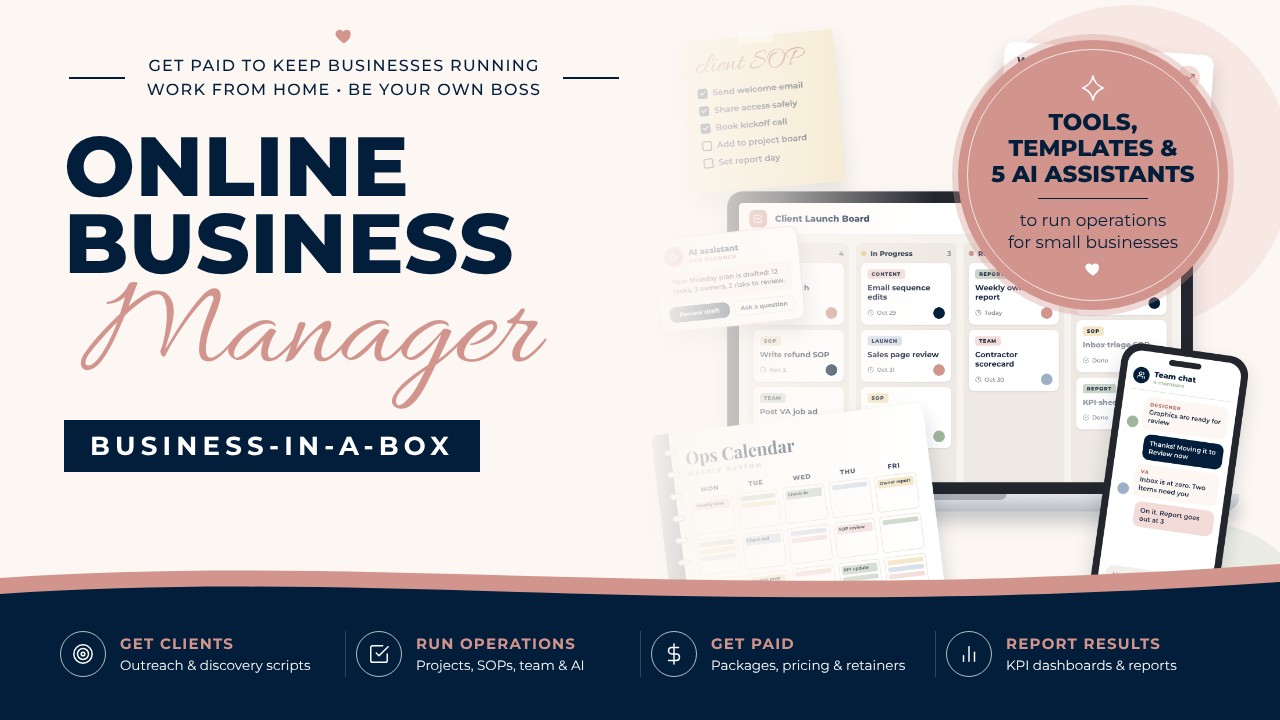
Ready to move up from VA? Get the OBM toolkit
Our Online Business Manager Business-in-a-Box gives you 12 modules, 52 short written lessons, 18 templates and 5 AI assistants in Claude (Ops Planner, SOP Writer, Team and Hiring Helper, Report Writer and Client Finder), plus the AI Ops Playbook bonus with 50 AI workflows. It’s $197, self-paced, with no videos to sit through.
OBM vs VA FAQ
Is an online business manager higher than a virtual assistant?
In most businesses, yes. An OBM usually manages operations and the team, which often includes VAs. It’s a different role with more responsibility, not just a fancier title.
Do OBMs make more than VAs?
OBMs usually charge more per client because they’re responsible for outcomes, systems and a team. VAs can also earn well, especially in a niche. Rates for both vary widely by skill, niche and location.
Does an OBM do VA tasks?
Sometimes, especially for a smaller client or at the start. But the goal is to delegate tasks to the team and focus on planning, systems and reporting. A clear package keeps the role from drifting back into task work.
Do I need a team to be an OBM?
No, but your clients usually have one. Managing their contractors is part of the job. Later, you might also bring on VAs under you, but that’s optional.
Can a new VA go straight into OBM work?
It’s possible if you have strong related experience, such as office management or project coordination. Most people do best getting some VA experience first, so they understand how online businesses run day to day.
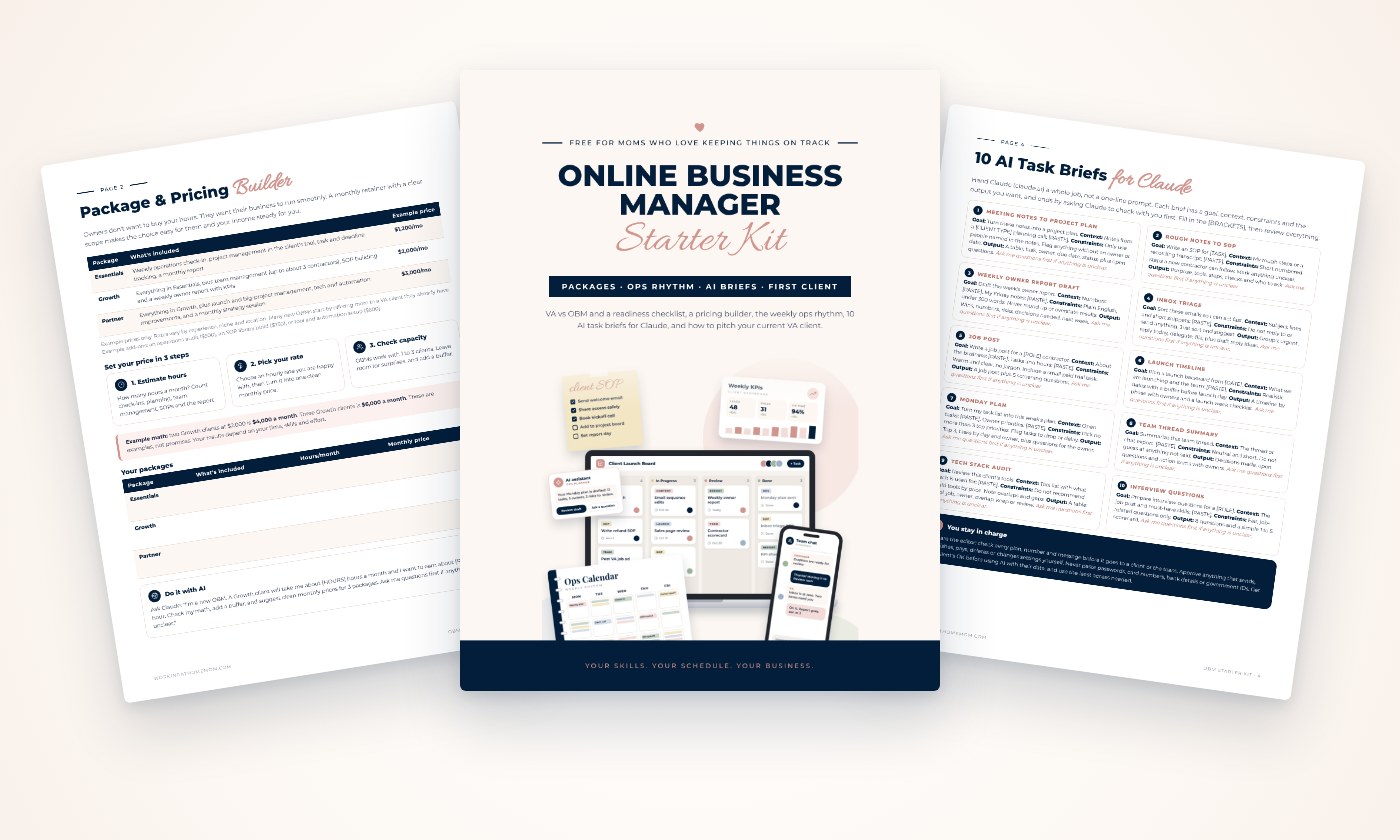
See if OBM work is your next step
Example OBM packages and pricing, a one-page weekly ops rhythm, 10 ready-to-paste AI task briefs and a script to pitch your current VA clients. Sent straight to your inbox.





