Virtual assistant jobs for beginners are one of the most realistic ways for a mom to start earning from home. The work is flexible, the startup costs are low, and many of the skills you need are ones you already use every day: organizing, communicating, keeping track of details and getting things done.
The hard part is getting hired that first time. In this guide we cover the types of beginner VA jobs out there, where to find them, how to apply with no experience, how to pass a trial task, and how to spot the scams that target new VAs.
If you want the full start-to-finish setup (picking services, building a portfolio, setting up your business), read our guide on how to become a virtual assistant first. This article is all about getting hired.
How to get hired as a VA with no experience: the quick answer
- Choose 2 or 3 beginner-friendly services you can do well right now.
- Turn your past jobs and mom skills into proof (a short skills list and 2 or 3 samples).
- Look for work in your network, on job boards, through VA agencies and by reaching out directly.
- Send short, tailored applications that focus on the client’s problem.
- Treat every trial task and interview like the real job.
- Start with a clear, small offer and grow from there.
What kinds of virtual assistant jobs are good for beginners?
“Virtual assistant” is a broad title. These are the areas where beginners most often get their start:
- Admin support: email management, calendar scheduling, file organization, data entry and travel booking.
- Customer service: answering customer emails, chat or support tickets for a small business.
- Social media assistant: scheduling posts, replying to comments and making simple Canva graphics.
- Online shop assistant: updating product listings, processing orders and answering buyer messages.
- Content support: uploading blog posts, formatting documents and proofreading.
- Personal assistant tasks: research, appointment booking and organizing a busy person’s to-do list.
For a much longer menu of ideas, browse our virtual assistant services list.
Tip: don’t try to offer everything. “I help busy coaches manage their inbox and calendar” gets more yeses than “I can do anything you need.”
Can you really get a virtual assistant job with no experience?
Yes. Many clients care more about reliability and good communication than a formal VA background. If you’ve ever run a household, organized a school event, worked in an office, handled customers in retail or managed a busy family calendar, you have relevant experience.
The trick is translating it into language a client understands.
Have office experience? Look at remote executive assistant jobs.
Translate your experience
- Organized the PTA fundraiser: “Coordinated a team of 15 volunteers, managed sign-ups in Google Sheets and sent weekly email updates.”
- Worked a retail job: “Handled customer questions and complaints with patience and solved problems quickly.”
- Ran the family schedule: “Managed multiple calendars, appointments and deadlines without missing a beat.”
- Former office job: “Experienced with email, scheduling, spreadsheets and keeping files organized.”
Do it with AI: open Claude (or ChatGPT) and paste: “I want to become a virtual assistant. Here’s my background: [LIST PAST JOBS, VOLUNTEER WORK AND EVERYDAY SKILLS]. Turn this into 6 short bullet points I can use on a VA profile or application, focused on skills small business owners value. Then suggest 3 sample projects I could create this week to prove those skills.” Then check and edit everything so it’s 100% true and sounds like you.
Make 2 or 3 quick samples
Samples show a client what you can do. Ideas you can make in an afternoon:
- An inbox system: a one-page document showing the folders, labels and rules you’d set up for a client.
- A research summary: compare 5 options for something a business might need, in a clean Google Doc.
- A content calendar: a month of social posts scheduled in a Google Sheet.
- A process document: step-by-step instructions for a common task, with screenshots.
Where to find virtual assistant jobs for beginners
1. Your own network
This is often the fastest route to a first client. Tell friends, family and former coworkers that you’re starting as a VA and what you help with. Small business owners in your circle may be overwhelmed and just waiting for someone they trust.
2. Job boards
Search Indeed, FlexJobs and LinkedIn Jobs for “virtual assistant,” “remote administrative assistant,” “executive assistant (part-time)” and “customer support (remote).” Set up job alerts so new postings come to you.
3. Freelance marketplaces
Upwork and Fiverr are full of people looking for VA help. Competition is high, so a clear profile focused on one or two services and personalized proposals make a big difference. Check each platform’s current fees and rules before you start.
4. VA agencies
Some agencies hire VAs and match them with clients. You’ll usually earn less than with your own clients, but someone else handles the marketing, and it’s a great way to build experience and confidence.
5. Reaching out directly
Look for busy business owners (coaches, realtors, podcasters, online shop owners) who post a lot and seem stretched thin. A friendly, short message offering help with one specific task can open doors.
For scripts and a weekly plan, see where to find virtual assistant clients.
How to apply for VA jobs when you’re new
Most applications get skipped because they’re generic. A short, specific one stands out instantly.
A simple application formula
- Show you read the post: repeat their main need in your own words. “You need someone to manage your inbox and schedule client calls.”
- Connect your experience: one or two lines on why you can do exactly that.
- Share a sample: link the most relevant one.
- Suggest a next step: “I’d love to hop on a quick call this week.”
Keep it under 200 words. Busy people appreciate brevity, and being clear and concise is exactly what they want from a VA.
Do it with AI: paste into Claude: “Here’s a virtual assistant job posting: [PASTE POSTING]. My relevant skills are [SKILLS] and my best sample is [DESCRIBE SAMPLE]. Write a warm, professional application under 180 words that leads with the client’s needs, connects my skills to them and ends by suggesting a short call.” Then check and edit it so it’s honest about your experience and matches your voice.
How to ace the interview and trial task
Many VA jobs include a short call and a small test task. This is your chance to shine.
Already working as a VA? See how the next step up compares in Online Business Manager vs Virtual Assistant.
- Prepare for common questions: what tools you use, how you stay organized, how you handle a mistake and how quickly you reply to messages.
- Ask good questions: what tasks take up most of their time, what success looks like in the first month, and how they like to communicate.
- Follow instructions exactly: trial tasks often test attention to detail as much as skill.
- Deliver early and clearly: send it before the deadline with a short note explaining what you did.
- Know the difference: a short paid or small unpaid test is normal. Hours of free “testing” that looks like real client work isn’t.
The basics you need to start
- A reliable computer and internet: plus a quiet spot for calls (nap time counts).
- Core tools: Google Docs and Sheets, email, and a video call tool. Learn Calendly, Trello, Asana and Loom as you go, since many clients use them.
- A simple agreement: scope, rates, payment terms and how either side can end the work.
- A way to get paid: invoicing through a tool like QuickBooks or another method your clients are comfortable with.
- Business basics: check your local rules for registering a business and talk to a tax professional about setting money aside.
Wondering what to charge? Our guide to how much a virtual assistant should charge walks you through the math, and how to make $2,000+ a month as a virtual assistant shows how retainers add up.
Red flags: VA job scams to avoid
- You’re asked to pay to get started: for training, software or equipment.
- They send you a check: and ask you to buy equipment or send part of the money back.
- Interviews happen only by text or chat app: with no video call and vague company details.
- Pay sounds too good: for very little work and no experience.
- They want sensitive information early: like your bank login or a copy of your ID before any contract.
If something feels off, research the company name plus the word “scam,” and trust your gut.
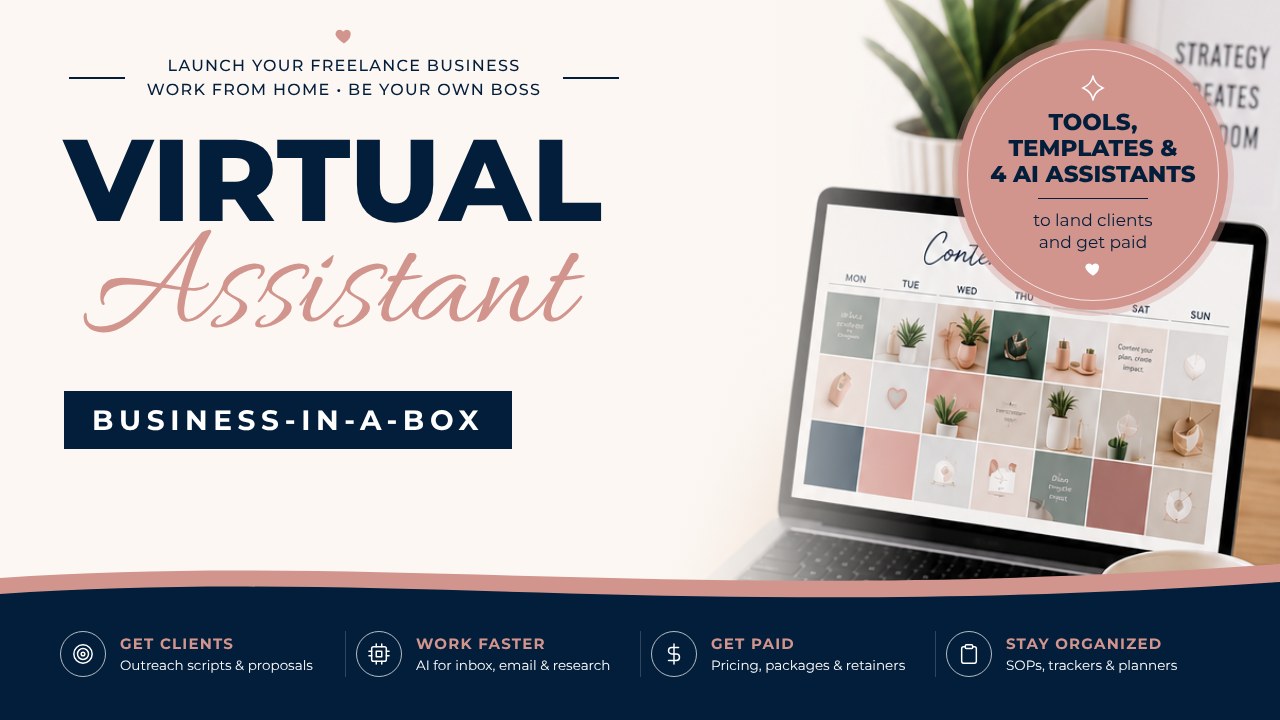
Get hired as a VA, even with no experience
Our Virtual Assistant Business-in-a-Box walks you through choosing services, finding clients and getting paid, step by step. It includes 12 modules, 19 templates and 4 AI assistants to start a VA business and get paid.
Virtual assistant jobs for beginners FAQ
How do I become a virtual assistant with no experience?
Start with skills you already have, pick 2 or 3 services, create a few samples, and reach out to your network and small businesses. Our step-by-step VA guide covers it in detail.
What is the easiest VA job for beginners?
Email management, calendar scheduling, data entry and simple customer service are common starting points. They rely on organization and communication more than specialized training.
Do I need a certification to be a virtual assistant?
No certification is required. Clients usually care more about reliability, clear communication and samples of your work. A course can help you get organized and confident faster.
Can I be a virtual assistant with kids at home?
Yes. Many VAs work around school hours and nap times. Be upfront about your availability, choose tasks that don’t need constant live response, and use scheduling tools to stay on track.
How long does it take to get your first VA job?
It varies. Some people land a client in a couple of weeks through their network; others take a few months. Consistent outreach and tailored applications speed things up.
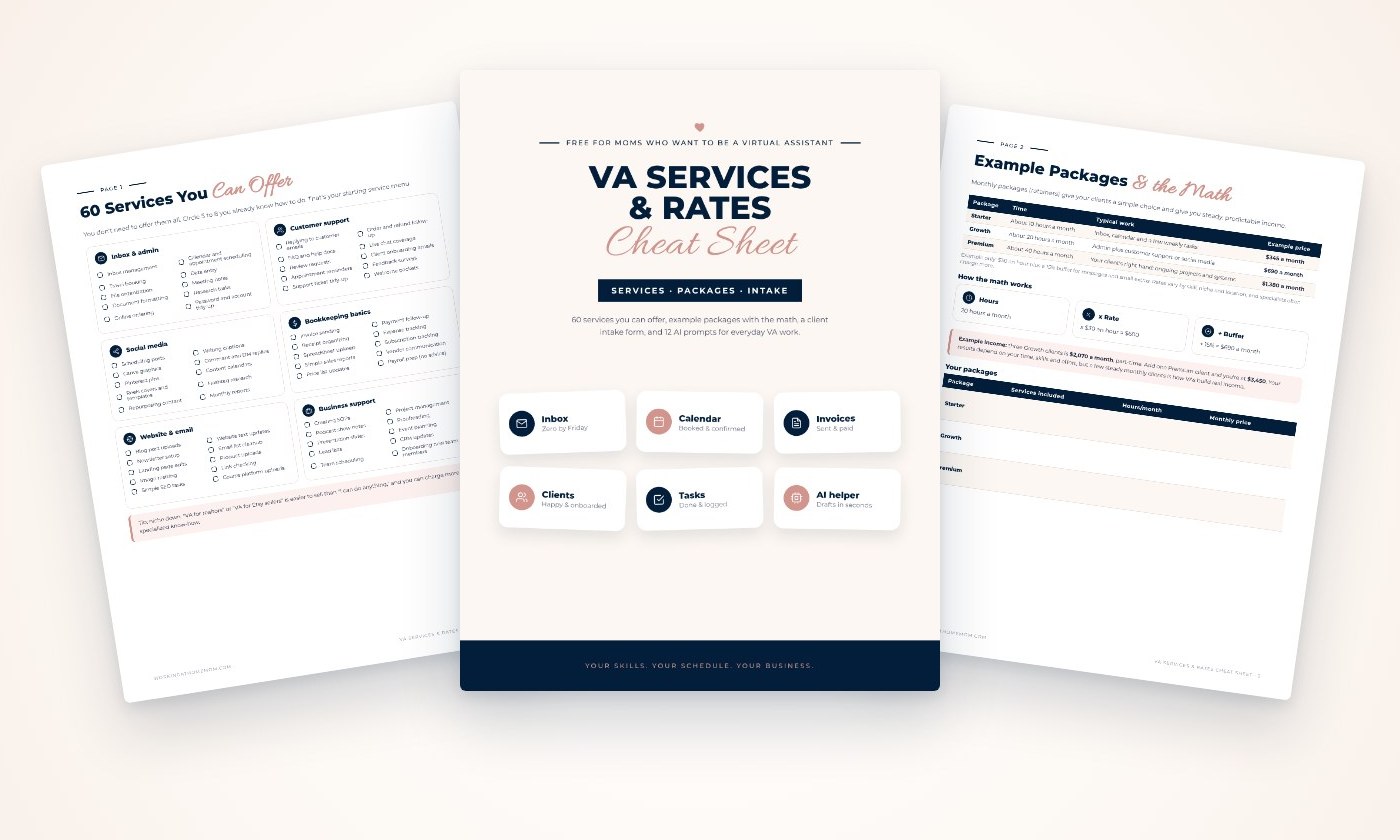
Get our free VA Services & Rates Cheat Sheet
60 services you can offer, example monthly packages with the math, a client intake form and 12 AI prompts. Sent straight to your inbox.