

What is a sales funnel? It’s the simple, planned path that turns a stranger into a customer. Someone finds a business, grabs something free, gets a few helpful emails and then decides to buy. A sales funnel is just that path, set up on purpose so it works every day without the owner chasing each person.
If you run a small business, a funnel can bring you leads and sales while you get on with your actual work. If you’d like to build funnels for other people, understanding the pieces is your first step.
In this guide we explain each stage and each piece in plain English, with simple examples for different kinds of small businesses.
What is a sales funnel: the quick answer
- A sales funnel is the step-by-step path from “just found you” to “just bought from you”.
- The stages: awareness, interest, decision and action, then what happens after the sale.
- The pieces: a traffic source, a free offer, an opt-in page, a thank-you page, emails, a sales page and a checkout.
- Common types: lead magnet funnels, sales funnels and launch funnels.
- Why it matters: it follows up with every interested person automatically, so fewer potential customers slip away.
What is a sales funnel, and why is it called a funnel?
Picture a kitchen funnel: wide at the top, narrow at the bottom. Lots of people hear about a business (the wide top). Fewer sign up for something free. Fewer still buy. The funnel shape simply shows that people drop off at each step, and that’s normal.
A good funnel does two jobs. It helps the right people move to the next step with clear, helpful information, and it lets the wrong-fit people leave without wasting anyone’s time.
The stages of a sales funnel
Different marketers use different names, but most funnels follow these stages:
- Awareness: someone discovers the business through a social post, a search, a podcast, a referral or an ad.
- Interest: they want to know more, so they sign up for a free checklist, guide, mini training or quote.
- Decision: over a few emails, they learn how the business can help, see honest proof and get their questions answered.
- Action: they buy, book a call or request a quote.
- After the sale: they get a warm welcome, access to what they bought and, later, a chance to buy again or refer a friend.
The pieces of a sales funnel
Here’s what a funnel is actually made of. Not every funnel uses every piece.
- Traffic source: where visitors come from, such as Instagram, Pinterest, Facebook, a blog, email or paid ads.
- Lead magnet: the free thing people sign up for, such as a checklist, template, short training, quiz or discount.
- Opt-in page: a short page with one job: get people to enter their name and email for the lead magnet.
- Thank-you page: confirms the sign-up, tells people what happens next and can mention a paid offer.
- Email sequence: a series of automated emails that deliver the freebie, build trust and introduce the offer.
- Sales page: explains the paid offer: the problem, the promise, what’s inside, who it’s for, proof, price and FAQ.
- Checkout or order page: where people pay, connected to the business’s own payment account.
- Tags and automations: the behind-the-scenes rules, such as “if someone buys, stop sending sales emails and send their login”.
Three common types of sales funnels
1. Lead magnet funnel
An opt-in page, a thank-you page and a short welcome sequence. Its goal is to grow an email list of interested people. This is the best first funnel for most small businesses.
2. Sales funnel
A sales page, checkout, thank-you page and a sales email sequence. Its goal is to sell a specific offer, such as a course, a program or a service package, every day of the year.
3. Launch funnel
A waitlist page, a sales page, a checkout and a series of launch emails, with enrollment open for a set window. Its goal is a burst of sales for an offer that opens and closes, like a group coaching program.
Local service businesses often use a fourth, simpler version: a quote or booking funnel, where the “sale” is a form submission or a booked call.
A simple sales funnel example
Say a yoga teacher sells a 6-week online program. Her funnel might look like this:
- Traffic: she shares short morning-stretch videos on Instagram and links to her freebie.
- Lead magnet: a free “7-Day Morning Reset” checklist.
- Opt-in page: a headline, three bullet benefits and a form for name and email.
- Thank-you page: “Check your inbox”, plus a short note about her program.
- Emails: day 0 delivers the checklist, then a quick win, her story, a helpful tip and an invitation to the program.
- Sales page and checkout: everything about the 6-week program, with a checkout connected to her own payment account.
Here’s how the numbers might work. Example: 1,000 people visit the opt-in page in a month, 35% sign up (350 subscribers), and 3% of those subscribers buy (about 10 sales). These are made-up numbers to show the idea. Real results vary widely, which is why funnels get tested and improved over time.
Sales funnel examples for different small businesses
- A local cleaning company: a “free quote in 24 hours” page, a short form, an instant confirmation email and a reminder to book.
- A business coach: a free workshop registration page, reminder emails, the workshop, then emails inviting people to a group program.
- A small candle shop: a “join for first access to new scents” opt-in, a welcome sequence telling the shop’s story, then emails featuring best sellers.
- A course creator: a free mini training, a 5-email sequence and an evergreen sales page for the full course.
Sales funnel vs website: what’s the difference?
A website is like a shop window: lots of pages, lots of choices, something for everyone. A funnel is like a guided tour: one path, one goal, one clear next step on each page.
Most small businesses benefit from both. The website builds credibility, and the funnel turns interested visitors into leads and customers. Many funnels live on the same domain as the website.
Does every small business need a sales funnel?
Not every business needs a complicated one, but most benefit from a simple one. Signs it’s time:
- People visit and vanish: there’s no way to stay in touch with interested visitors.
- Follow-up happens by hand: the owner replies to every inquiry one by one, when they remember.
- Social media is the only channel: an email list is something the business controls; a social account is not.
- Launches are stressful: sales only happen when the owner pushes hard.
How to build a simple sales funnel in five steps
- Get clear on the offer: who it’s for, the problem it solves, the price and the proof you really have.
- Map it on one page: every page, email, tag and goal, in order.
- Write the copy: the opt-in page, thank-you page, emails and sales page.
- Build and connect: create the pages in a page builder, connect the form, emails and checkout, and add simple automations.
- Test, launch and improve: check every link and email, go live, then change one thing at a time based on the numbers.
You can build all of this in Bonidi, the all-in-one system we use, or in tools like ClickFunnels, Kajabi, Systeme.io or WordPress with an email tool.
Do it with AI: paste this into Claude: “Goal: map a simple sales funnel for my business. Context: I sell [OFFER] at [PRICE] to [AUDIENCE], who struggle with [PROBLEM]. My visitors mostly come from [TRAFFIC SOURCE]. Constraints: keep it to the fewest pages and emails that will work, and suggest a lead magnet that leads naturally to my paid offer. Output: 3 lead magnet ideas, then a funnel map listing each page and email in order with its one goal. Ask me questions first if anything is unclear.” Then check that every idea fits what you really offer and edit it to suit your business.
Keep your funnel honest (and legal)
The best funnels build trust. A few rules we always follow:
- No fake urgency: no countdown timers that reset and no “only 3 spots left” unless it’s true.
- No invented proof: use only real testimonials and results, with permission.
- True claims only: income and health claims need to be true and backed up.
- Email rules: people must opt in, and every marketing email needs an unsubscribe link and a business address. Some places have stricter consent rules, so check local requirements or ask a professional.
- Accessible pages: readable contrast, alt text on images, real text instead of text baked into images, and buttons that say what they do.
For the people who build them
Here’s the part many small business owners don’t know: they don’t have to build their funnel themselves. Funnel builders plan, write, build and test funnels for them, usually per project, often with a monthly care plan afterward.
It’s a great work-from-home business for organized moms who like writing and tidy systems, and AI now does many of the first drafts. If that sounds like you, read how to become a funnel builder, see example packages in how much do funnel builders charge, and learn the workflow in how to use AI to build sales funnels.
Turn funnel know-how into a business
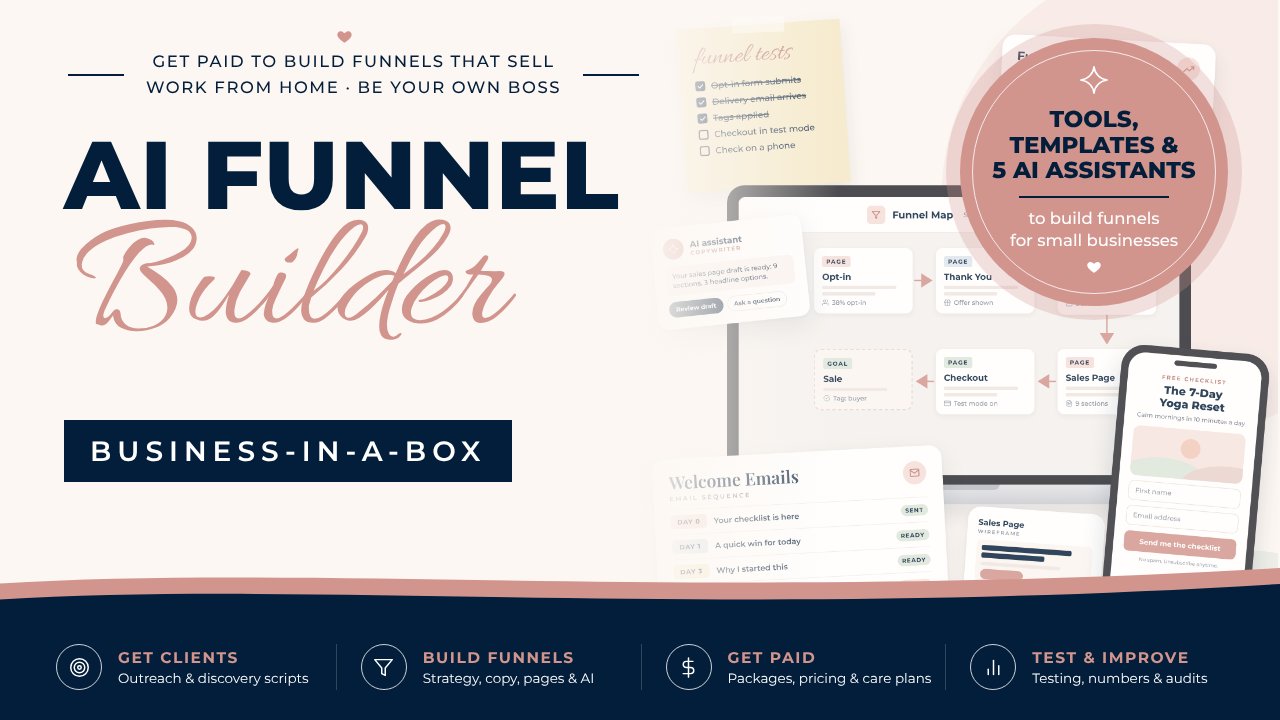
Our AI Funnel Builder Business-in-a-Box gives you 12 modules, 52 short written lessons, 18 templates and 5 AI assistants in Claude (Funnel Strategist, Copywriter, Email Writer, Page Builder Helper and Client Finder), plus the AI Funnel Playbook bonus with 50 AI workflows and a swipe file of 10 page outlines. It’s $197, self-paced, with no videos to sit through.
Sales funnel FAQ
What is a sales funnel in simple terms?
It’s the path a person follows from first hearing about a business to buying from it. Usually that means a free offer, a sign-up page, a few emails and then a paid offer with a checkout.
Do I need a sales funnel if I’m on social media?
Social media is great for being found, but you don’t control the platform or who sees your posts. A funnel moves interested followers onto your email list, where you can stay in touch on your own terms.
What do I need to build a sales funnel?
A clear offer, a lead magnet, a page builder, an email tool and a way to take payments. All-in-one systems combine most of these in one place. Check current pricing for any tool you consider.
How much does it cost to have a sales funnel built?
It varies widely, from very cheap marketplace templates to agency projects costing many thousands. As an example, the packages we teach range from $500 to $750 for a lead magnet funnel up to $2,500 for a launch funnel.
What is a good conversion rate for a funnel?
It depends on the audience, the offer, the traffic source and the price, so there’s no single number to aim for. Track your own numbers, change one thing at a time and compare against your past results.
Map your first funnel on one page
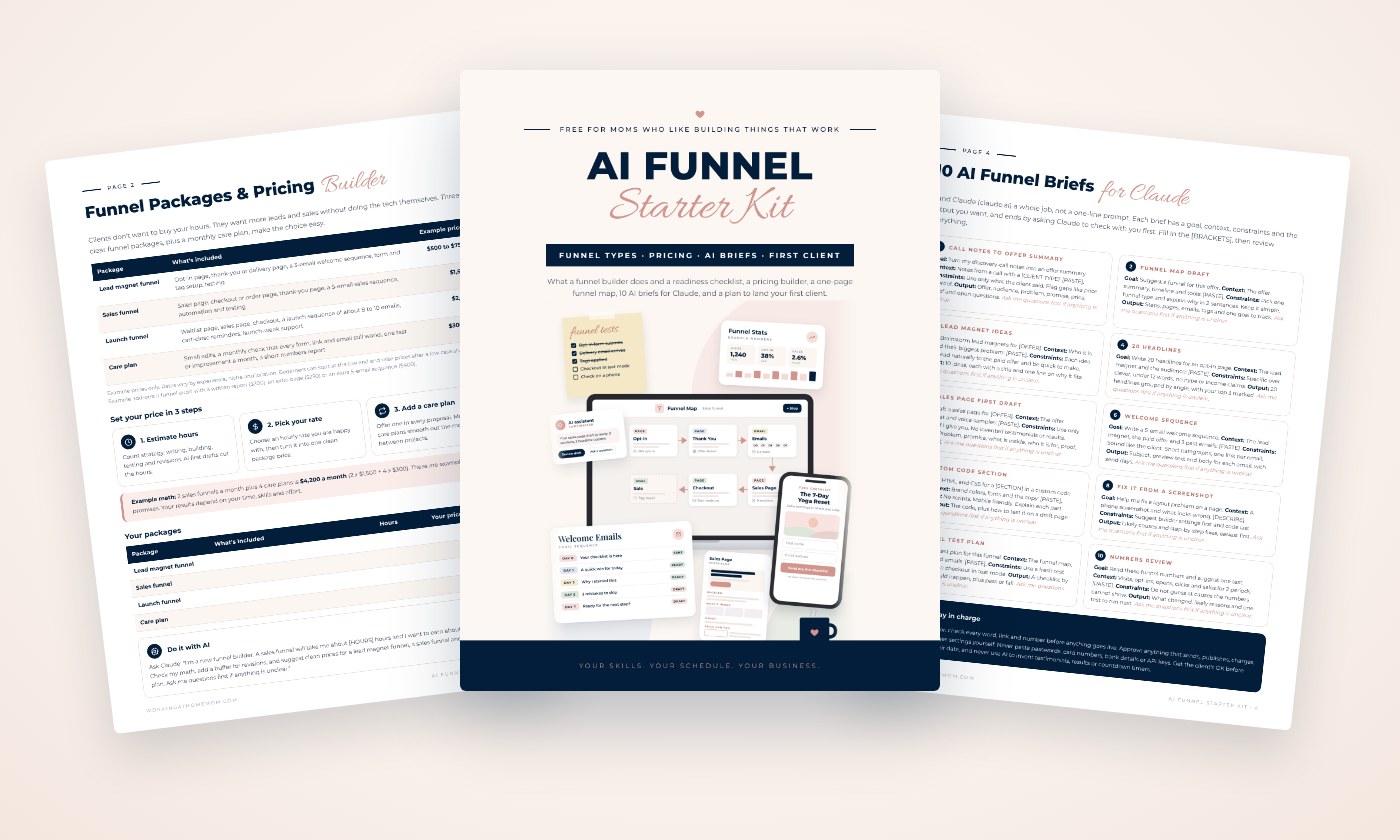
Example funnel packages and pricing, a one-page funnel map, 10 ready-to-paste AI briefs for funnel copy and emails, and a 10-step plan to land your first client. Sent straight to your inbox.





